
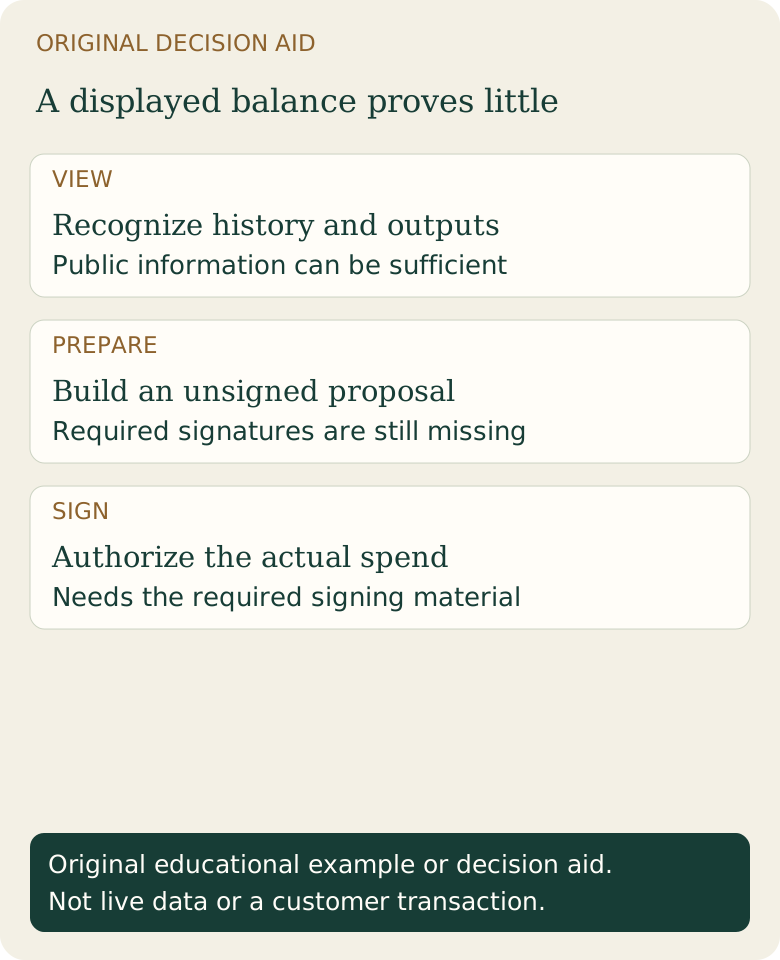
What does “watch-only” mean?
The wallet has enough public information to recognize certain transactions or outputs, but lacks the required private signing keys for that setup. Depending on the software, it may track an individual address, an extended public key, or a public descriptor covering a set of addresses.
A watched balance may belong to you, a separate offline wallet, or someone entirely unrelated. Importing public information does not transfer Bitcoin or give the importer permission to spend it. No website can turn a public address into its private key by collecting an activation fee.
Separate three different capabilities
Scroll across the table to see all columns.
| Capability | What may enable it | What it does not imply |
|---|---|---|
| View a transaction or balance | Public address information may be enough | Does not establish ownership or control |
| Prepare an unsigned transaction | Wallet knows relevant outputs and destination details | Still needs the required signatures |
| Sign and spend | Required signing keys or authorized signing devices | Must satisfy the actual spending conditions |
How does a legitimate offline arrangement work?
Electrum’s official cold-storage guide describes a watching-only online wallet paired with an offline signing wallet. The online side can prepare an unsigned transaction; the offline side supplies signatures; the signed transaction can then be broadcast. Each step has its own security checks.
This explanation is not a setup tutorial for moving real funds. Confirm the current software’s verified download, backup, device and transaction-review requirements before using it. The actual signer must inspect the recipient and amount; an unsigned file from an untrusted machine is not automatically safe.
Does public-only mean harmless to share?
An extended public key can reveal a much broader set of wallet addresses and activity than one receiving address. The privacy impact depends on the wallet and account structure. A descriptor or address list can also expose associations you did not intend to disclose.
Treat this information as sensitive financial context even when it cannot authorize spending by itself. Do not submit an entire public-key inventory to a support form when a single relevant transaction reference would answer the question. This guide never asks you to import a key or upload wallet material.
Example: a balance offered for an “unlock fee”
Fictional situation: a stranger provides a public address showing 0.8 BTC and asks you to import it into a wallet. The wallet displays the same balance. The stranger then demands 0.01 BTC for a key, upgrade or tax clearance. The imported display establishes no entitlement to that 0.8 BTC.
Stop rather than sending the fee. Verify claims through the actual service’s official channels and keep the records. For your own recovery, identify whether your backup contains signing material or only public information using the backup guide. For purchasing, use a receiving address from a wallet whose access and backup you understand; see wallet compatibility.
Sources & further reading
These sources explain the payment systems and rules discussed in this guide. For your purchase, check the provider’s current offer and terms.
- Electrum: Offline and watching-only wallets
- Bitcoin.org: Securing your wallet
- Bitcoin developer guide: Transactions
Published by Fiat2Bitcoin. Worked examples use fictional figures and records; they are not current prices or customer transactions. How we prepare our guides.