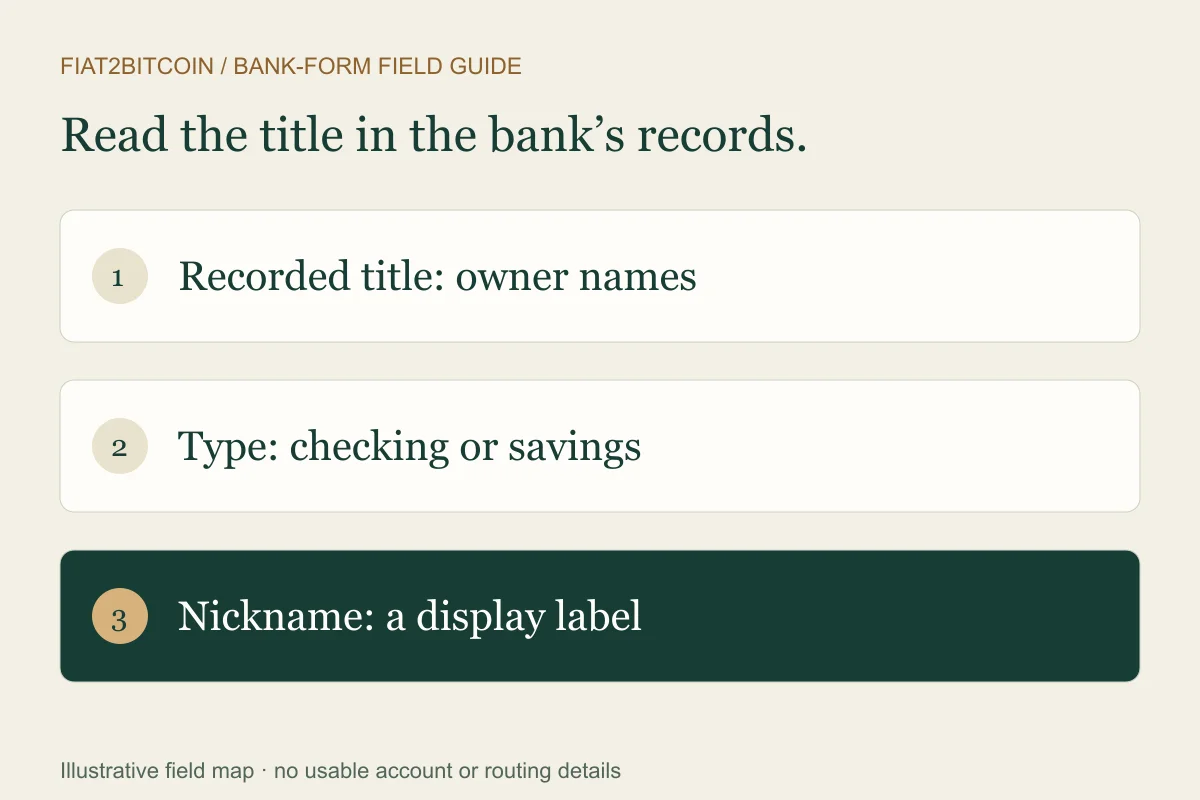
A direct-deposit form asks for “depositor account title.” It is not asking for your job title or a label such as Checking. This guide focuses on the banking and SF 1199A meaning; “account title” in bookkeeping can instead name a ledger account, such as rent expense.
What does depositor account title mean?
The title is how the bank identifies the deposit account’s named owner or arrangement in its records. A simple personal title may contain one owner’s name. Joint, business, representative-payee or custodial arrangements can have more detailed titles. Do not decide the ownership arrangement from a shortened display name.
Treasury’s direct-deposit enrollment guidance includes the depositor’s account title among the information completed by the financial institution and says it must include the person authorized to receive the payment. This is guidance for the federal enrollment process, not a rule that every commercial payment form has identical wording.
The account-holder guide explains owners and authorized signers more generally. This page concentrates on the title field and responsibility for completing the federal form.
Who fills in the depositor account title on SF 1199A?
On the current GSA-hosted SF 1199A, “Depositor Account Title” appears in Section 3, labelled for completion by the financial institution. The form’s directions have the payee complete Sections 1 and 2, then have the financial institution verify that information and complete Section 3.
Read the instructions on the actual form version and the paying agency’s current submission process. Do not sign the financial institution’s certification or fill a bank-only section on its behalf. If the agency uses an online enrollment process instead, follow that process rather than assuming it uses the paper form.
Ask your bank: “Can you confirm the exact account title for this account and complete or verify the financial-institution section required by this form?” Keep the request inside the bank’s secure channel.
Title, account type and nickname: an example
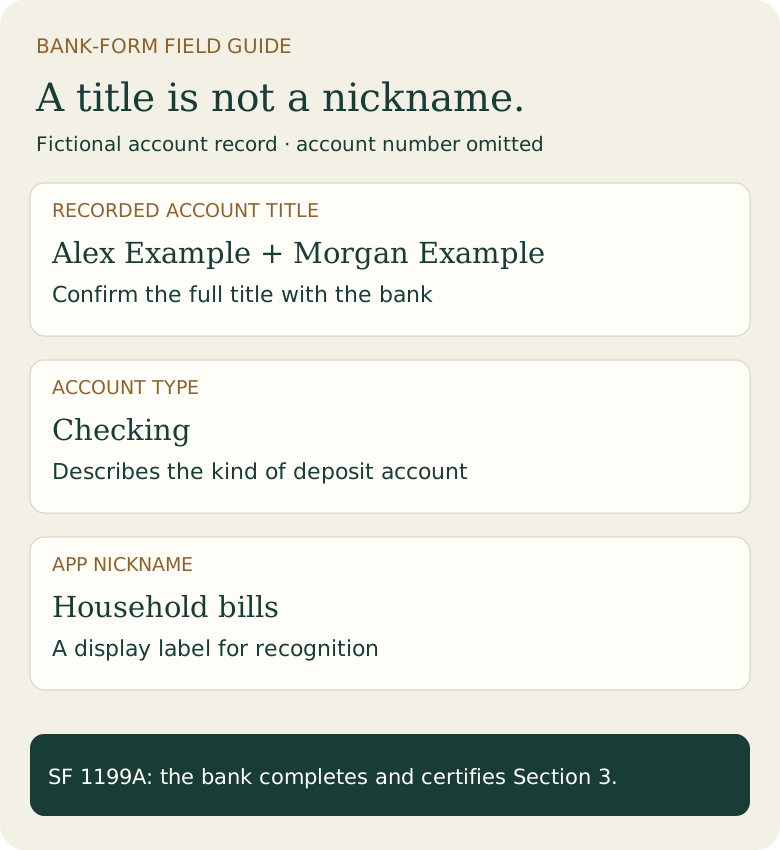
The following entries are fictional and contain no usable payment identifiers. They show why three familiar-looking labels can be different.
Scroll across the table to see all columns.
| Item | Fictional value | Meaning |
|---|---|---|
| Recorded account title | Alex Example and Morgan Example | Names shown in the invented bank ownership record |
| Account type | Checking | The kind of deposit account |
| App nickname | Household bills | A private display label chosen for recognition |
| Account number | OMITTED | An identifier separate from the account title |
Where do you find the recorded title?
Start with a recent bank statement or an official account-details document. Check that it refers to the intended account using its last digits privately. A customer profile, debit card or saved nickname can show a different name from the account’s complete title.
If the statement abbreviates a name or the account has a special ownership arrangement, ask the bank for the exact title it records and the documentation it can provide. The bank-verification-letter guide explains requesting specific account facts without assuming every reviewer accepts the same document.
A title should not be reconstructed by combining the name you prefer with the bank’s brand. Resolve an outdated name, business trading name or missing joint owner through the institution that maintains the record.
What about joint accounts or a different payee name?
A joint title can name more than one person, while a payment program can have its own conditions about who may receive the payment. Being an authorized signer does not by itself tell you how the account is titled or whether the paying organization accepts that arrangement.
Social Security’s SF 1199A completion guidance directs staff to check the accuracy of an account title when a signer is not shown in it. Use that as a reason to resolve discrepancies with the bank and relevant agency, not as permission to add someone to an account title yourself.
For representative-payee, trust or custodial accounts, ask the bank and paying agency to confirm the required title and authority. This guide does not determine eligibility, account ownership or entitlement to a benefit.
How this relates to other bank-payment forms
Other forms may ask for “account name,” “account holder” or “name on account.” Work out whether the question concerns your sending account or a receiving account, then use the record that the form actually requests. A nickname is a separate display label.
A beneficiary name identifies a payment recipient, and the beneficiary bank identifies that recipient’s institution. These roles should not be merged with the title of an unrelated account.
For a purchase-provider checkout, follow its account-ownership and payment requirements. A federal direct-deposit form is not a way to fund a Fiat2Bitcoin purchase. Compare purchase methods for current options; Fiat2Bitcoin does not receive customer wire funds or issue bank instructions.
Sources & further reading
These sources explain the payment systems and rules discussed in this guide. For your purchase, check the provider’s current offer and terms.
- GSA: SF 1199A, Section 3 and completion directions
- Treasury: Green Book, direct-deposit enrollment and account title
- Social Security: Completing SF 1199A and checking account-title discrepancies
Published by Fiat2Bitcoin. Worked examples use fictional figures and records; they are not current prices or customer transactions. How we prepare our guides.