‘Buy a little each week’ leaves several practical questions unanswered. Does $25 mean the complete card charge or the amount before fees? Will each purchase reach your wallet? What happens if your payment fails? This guide works through those decisions without assuming that a recurring Bitcoin purchase suits your finances.
How dollar-cost averaging works
You choose a fixed cash amount and a recurring interval, such as $100 on a particular day each month, instead of choosing a new amount in response to each price move. When the conversion price is lower, the same dollars buy more BTC; when it is higher, they buy less.
FINRA’s explanation describes this regular, equal-portion approach and its tradeoffs. A schedule can reduce decisions driven by emotion, but spreading purchases out can leave cash uninvested during rising prices. Buying gradually also remains exposed to a falling asset price.
There is a practical distinction between investing money as you earn it and spreading an already available lump sum over time. The second choice deliberately delays using some available money. Neither choice removes the need to decide whether Bitcoin exposure fits your budget and loss tolerance.
Calculate the average from total dollars and total BTC
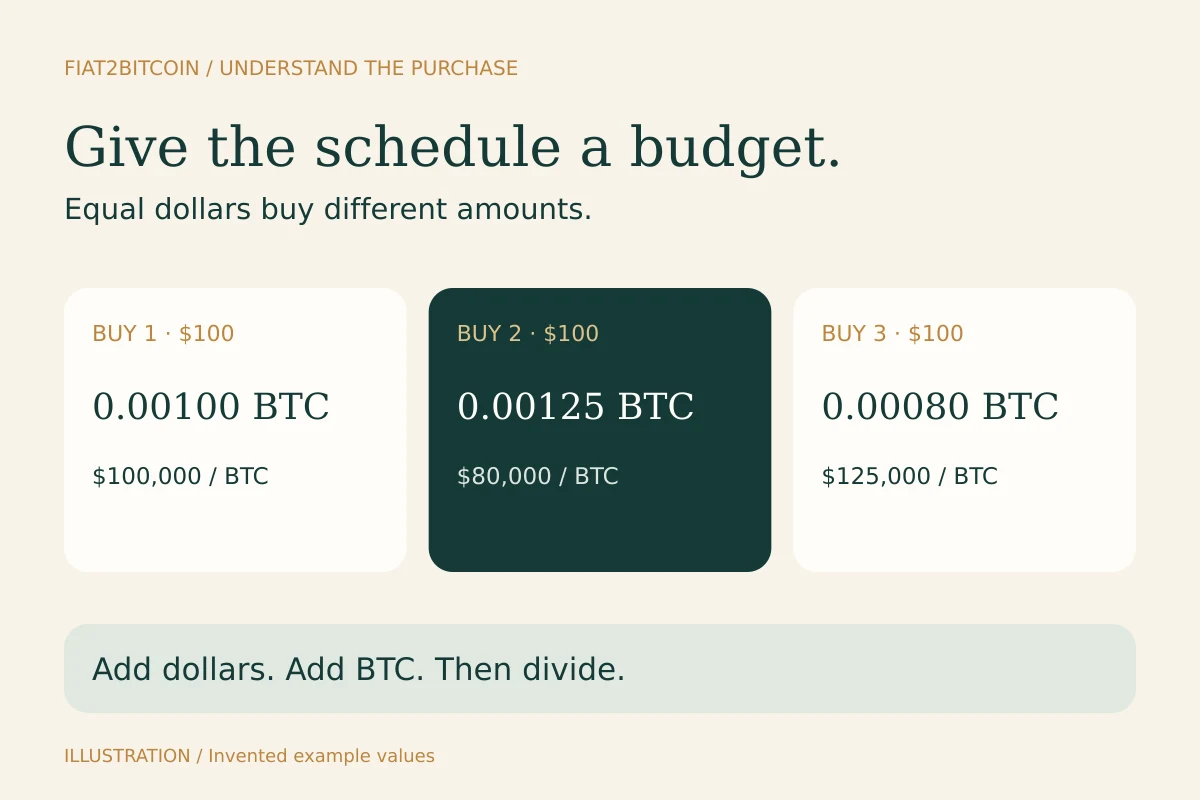
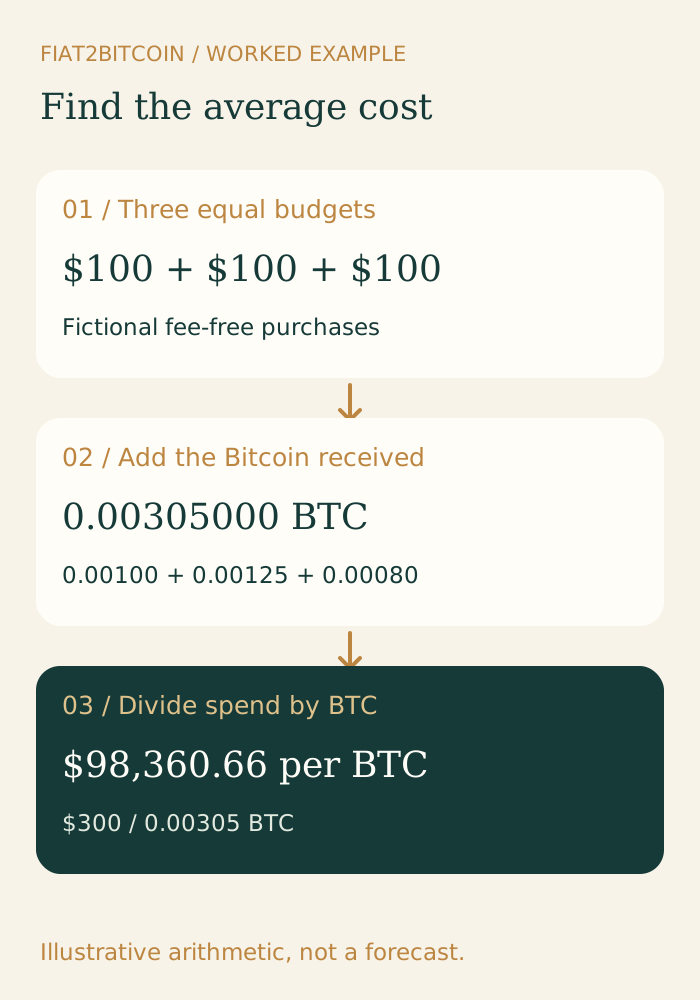
This invented example uses three $100 purchases and excludes every fee solely to make the averaging calculation easy to inspect. The prices are arithmetic inputs, not historical Bitcoin prices or a forecast.
Scroll across the table to see all columns.
| Purchase | Example price per BTC | BTC received |
|---|---|---|
| 1: spend $100 | $100,000 | 0.00100000 |
| 2: spend $100 | $80,000 | 0.00125000 |
| 3: spend $100 | $125,000 | 0.00080000 |
| Total: spend $300 | $300 ÷ 0.00305 BTC | 0.00305000 |
The average purchase cost is $300 ÷ 0.00305 BTC = $98,360.66 per BTC. Simply averaging the three displayed prices gives $101,666.67, which is the wrong calculation for these equal-dollar purchases: the amounts of BTC bought at those prices differ.
For your own spending record, use complete dollars paid and actual BTC received. Keep each receipt so you can explain fees and delivery. This effective purchase-cost calculation is a budgeting measure; the records and adjustments used for tax reporting depend on the applicable rules.
Try a recurring-purchase fee plan
Make repeated fees visible.
See how one flat charge per purchase affects a fixed spending budget. Enter the fee included in each purchase’s total.
4 purchases of $50.00
For comparison, one purchase with the same flat fee leaves $198.00 after $2.00 in flat fees. The difference in modeled flat fees is $6.00.
This comparison holds the flat fee constant and splits the complete budget as evenly as possible to the cent. Percentage charges, spreads, outside issuer costs and changing Bitcoin prices need their own review. This tool neither predicts BTC returns nor schedules a purchase.
Your inputs stay in this page’s memory and clear when you reload. No account, wallet or download required.
Enter the complete budget for a chosen period, the number of purchases and a flat fee included in each purchase. The planner shows how much of that budget goes to those flat fees, then compares one purchase using the same fee. Its starting figures are invented examples, not provider prices.
Count the actual dates in your plan. A $50 weekly purchase can mean $200 in a four-purchase month or $250 in a five-purchase month before any outside charge. Using four as the purchase count is an illustration, not a conversion rule for every calendar month.
If a service charges a percentage, varies its fee by order size or adds costs outside the entered budget, use its full current quote as well. This planner isolates one flat charge per purchase; the conversion rate and time of purchase can still change the BTC received.
Check what purchase frequency does to fees
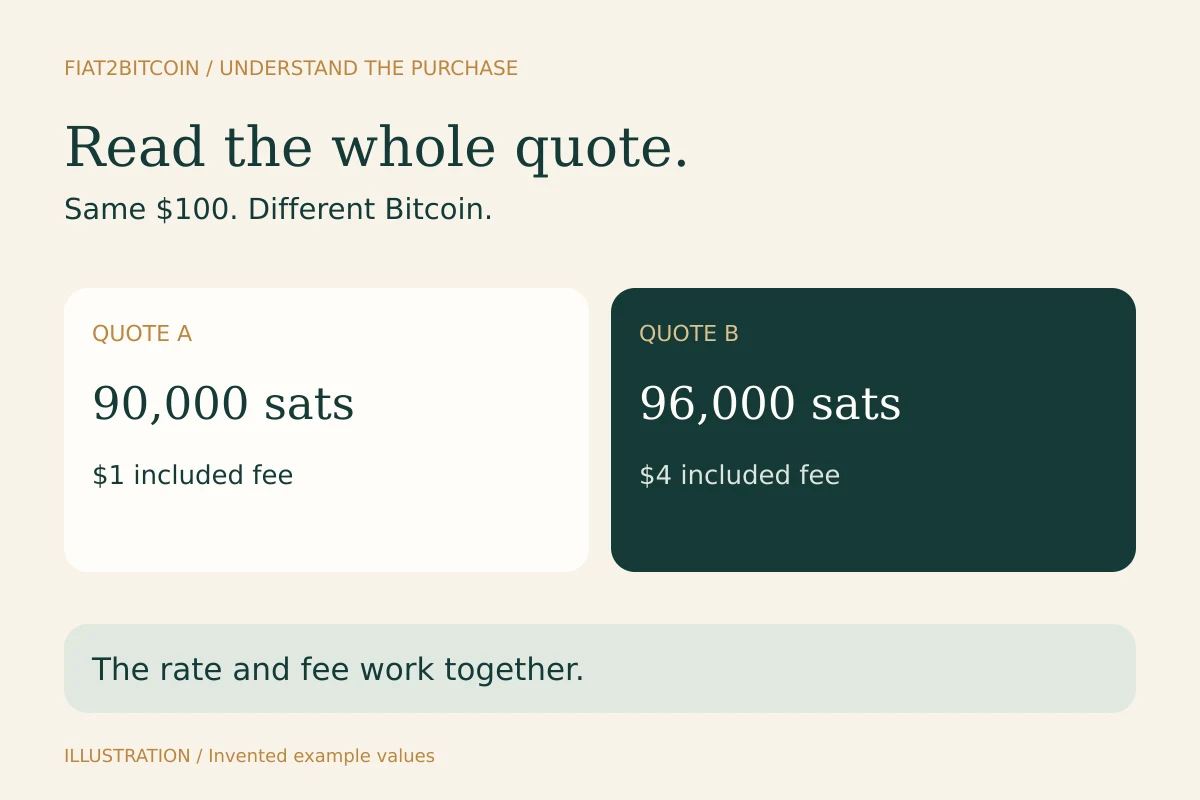
A small flat charge can take a large share of a small order. For example, an invented $2 charge on a $25 complete budget consumes 8% before any rate adjustment. The same $2 is 2% of a $100 budget. Actual providers may use minimum charges, percentages or changing quotes rather than either example.
Consider four fictional $50 complete budgets versus one $200 complete budget, with an invented $2 included fee per order. Four purchases leave $192 for conversion after $8 in fees. One leaves $198 after a $2 fee. That $6 difference describes fees only: the purchases happen at different times, so it cannot predict which schedule delivers more BTC.
Compare your intended amount at the actual interval. Fidelity’s DCA discussion covers the role of timing and transaction costs. For Bitcoin purchases, record the full amount paid and BTC received instead of assuming a larger or less frequent order always wins.
Decide where each purchase finishes
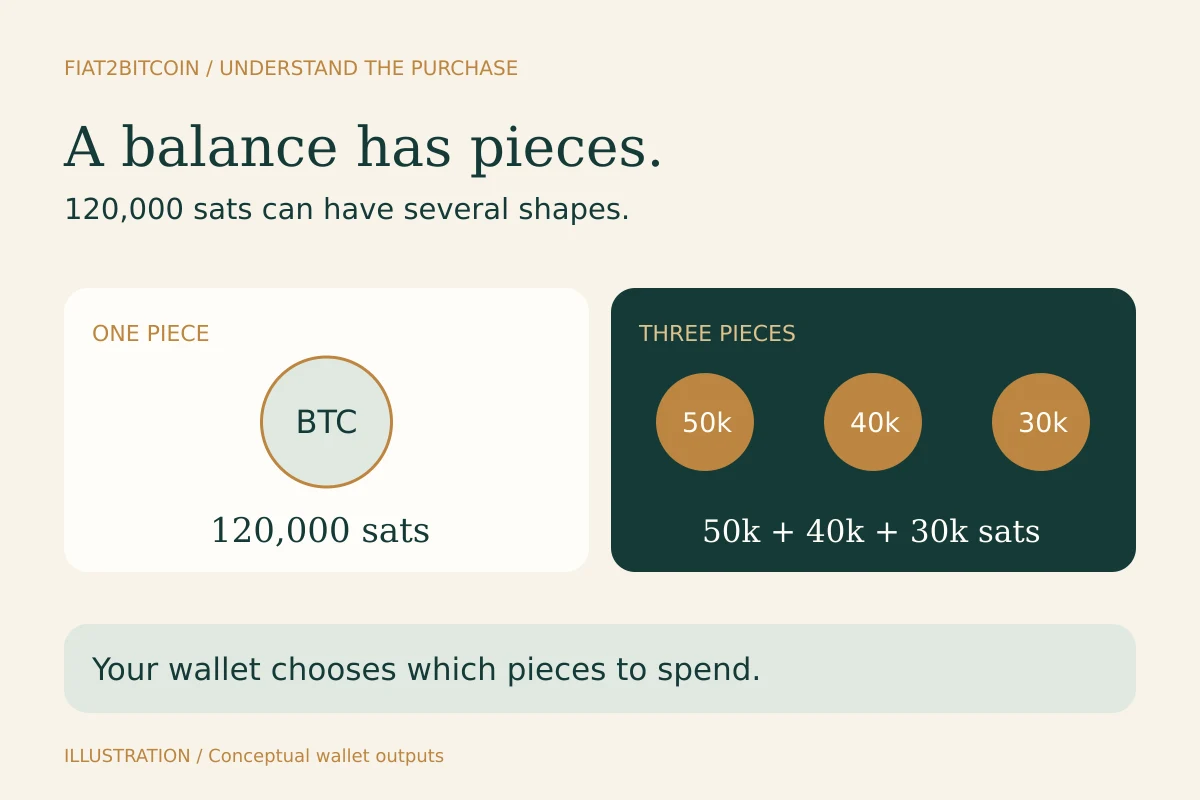
An on-platform BTC balance and BTC delivered to a wallet you control involve different arrangements. If the provider keeps purchases in an account, review its withdrawal minimum, charge and any hold. If it sends each purchase on-chain, repeated receipts can create several spendable outputs in your wallet.
The UTXO guide shows why combining many small Bitcoin receipts later can require a larger transaction. A plan that accumulates funds with a custodian for fewer withdrawals also changes how long you rely on that service. Compare those responsibilities alongside fees, rather than choosing solely by the number of transfers.
Fiat2Bitcoin’s current connected purchase flow uses eligible provider offers through Changelly and the customer’s Bitcoin mainnet receiving address. Each purchase follows its own quote and provider checks. This guide does not activate an automatic recurring order or advertise a recurring-buy feature on Fiat2Bitcoin.
Write a five-line purchase plan
Use an amount that leaves essential expenses and emergency needs covered. Investor.gov’s crypto-asset overview explains the exposure to price swings and the possibility of losses. A calendar does not cap that loss.
Scroll across the table to see all columns.
| Decision | Write down |
|---|---|
| Complete payment budget | The maximum total bank/card charge, including known outside costs. |
| Timing | The intended date and how you will handle weekends or insufficient funds. |
| Review trigger | A budget change, fee change, failed payment or change in your loss tolerance. |
| Destination | Your custody choice, supported network and expected delivery or withdrawal steps. |
| Records | Where you will keep each provider receipt, USD total, BTC amount and delivery reference. |
What if a scheduled purchase fails?
Check the provider’s order history and payment record before making a second attempt. A pending card authorization can appear while an order is still under review. The provider should explain whether the order failed, is still processing or requires action. Avoid adding an extra purchase just to make the calendar look complete.
Review the account’s rules for retries, cancellation, notices and the next scheduled order. If the service automatically retries, a separate manual order could create two purchases. Keep any support conversation linked to the existing order reference and review your budget before changing the schedule.
For a new manual purchase, use the current quote comparison to examine available estimates under your actual conditions. Keep the chosen schedule separate from the provider’s present price, eligibility and processing checks.
Sources & further reading
These sources explain the payment systems and rules discussed in this guide. For your purchase, check the provider’s current offer and terms.
- FINRA — Benefits and limitations of dollar-cost averaging
- Fidelity — Dollar-cost averaging and tradeoffs
- Investor.gov — Crypto asset-related investments and price risk
Published by Fiat2Bitcoin. Worked examples use fictional figures and records; they are not current prices or customer transactions. How we prepare our guides.