
Which kind of help matches your problem?
A person advertising “Bitcoin recovery” could mean data repair, password work, transaction tracing, account support or legal representation. Start with a short description of what happened and the records you still control. Keep wallet secrets and the only copy of a backup out of that first conversation.
The map below separates the job from the claim. It is our decision aid, not a list of vetted firms or a finding that your funds can be recovered. For a supported Bitcoin Core backup, the Core recovery guide covers a separate, documented offline restore example.
Scroll across the table to see all columns.
| Situation | The initial route to investigate | Boundary to establish |
|---|---|---|
| Wallet file exists; access is lost | Wallet-specific backup or encryption diagnosis | File type, backups and required access |
| Drive is failing or damaged | Qualified storage/data recovery | Preserve the original; avoid repeated writes |
| Hosted-platform account is inaccessible | The platform’s independently located support | Account ownership and its official recovery process |
| Funds were sent to a suspected scammer | Prompt platform contact and official fraud reporting | Tracing, legal process and returning assets are separate tasks |
What should a recovery claim be able to explain?
The FBI’s cryptocurrency-recovery alert describes businesses that sell misleading tracing or recovery promises and sometimes claim law-enforcement connections. It explains that a private company cannot issue a seizure order; an exchange follows its own processes and applicable legal process. A trace therefore needs a separate explanation of any realistic next step.
If someone approaches you after a loss, independently find the real platform or agency’s contact details. The FBI describes schemes that demand more money after an initial fee or inaccurate tracing report. A new “validation deposit” or “release fee” demanded by a stranger can deepen the loss; stop and verify the claimed authority before sending anything.
Scroll across the table to see all columns.
| Claim in an offer | Question to resolve | Record to request |
|---|---|---|
| “We know where the BTC went” | What observations support that conclusion, and what is uncertain? | Dated references and a readable method; no promise of seizure |
| “We work with an agency” | Can the named agency independently confirm the relationship? | Contact found on the agency’s own website |
| “We can repair your wallet” | Which file/software problem is in scope? | Written procedure, access limits and original-backup handling |
| “You pay only on success” | Which charges apply before success, and how is success defined? | All fee triggers, caps and cancellation terms in writing |
What belongs in a written engagement?
Check the legal business name, independently located contact route, contracting entity and relevant experience with the specific wallet or device problem. If legal work is proposed, verify the individual’s standing through the relevant official professional register. Business registration, search position and social-media testimonials answer different questions from whether the proposed technique fits your case.
Ask what the deliverable is: a diagnosis, repaired copy, password-search attempt, tracing report or legal work. Record exclusions, who can authorize additional work, where sensitive copies would be stored, retention/deletion terms and how you can stop. A sample report should use redacted or fictional data, without exposing another client’s records.
For storage work, preserve an untouched original and discuss the handling of copies before sending a device. For wallet work, insist on a clear access plan. A service that receives an encrypted wallet file may still receive sensitive history or material that becomes spendable if the encryption is defeated. Minimize what you disclose and understand the consequence before granting access.
A fictional fee proposal: identify each trigger
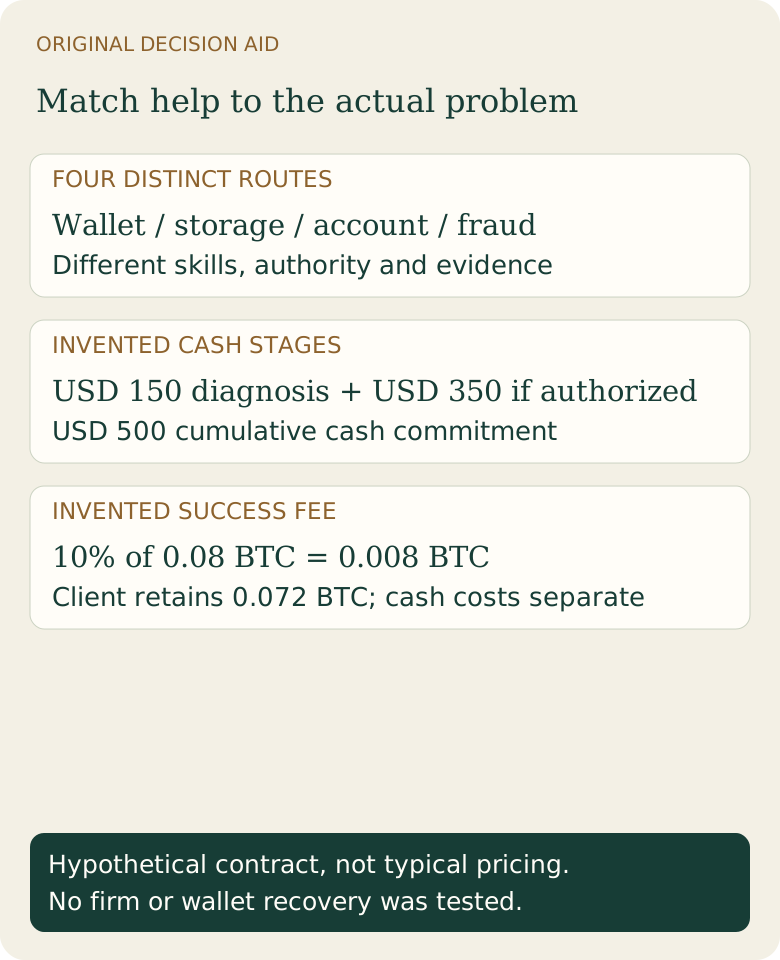
For a hypothetical wallet-file diagnosis, invent a written proposal with a USD 150 diagnosis charge and a separate USD 350 technical-work stage that requires fresh authorization. If both charges are payable, the cash commitment is USD 500 even if the work returns no BTC. A “success-only” headline would omit those obligations unless they were clearly disclosed.
Now invent a further fee of 10% of BTC actually recovered, with no other charges. If the outcome were 0.08000000 BTC, that fee would be 0.00800000 BTC, or 800,000 satoshis; the client would retain 0.07200000 BTC, or 7,200,000 satoshis, before any other costs. The separate USD 500 remains a separate expense. This arithmetic describes an invented contract, not typical fees, a recommendation to pay or a recovery forecast.
Scroll across the table to see all columns.
| Trigger | Invented obligation | What to clarify |
|---|---|---|
| Diagnosis authorized | USD 150 | Whether owed if the answer is “cannot proceed” |
| Separate technical stage authorized | USD 350 more; USD 500 cumulative | Who authorizes it and whether a cap applies |
| Illustrative actual recovery of 0.08 BTC | 10% = 0.008 BTC | Recovery definition, fee base and settlement method |
| Client’s BTC after that success fee | 0.072 BTC | USD charges and any other costs remain separate |
Which information should stay private?
Never send recovery words or private keys in a lead form, unsolicited chat or “wallet validation” website. Coinbase Wallet’s own recovery-phrase guidance is one concrete example: the user controls that wallet’s phrase, and Coinbase says it never asks for it. Other wallet designs have different restoration procedures; start from the official documentation for yours.
Keep sign-in codes, passwords and remote-control access private while assessing an offer. A public transaction ID can help explain an event but reveals transaction history; share only what the official recipient needs. The seed-phrase guide explains spending authority, and the transaction-ID guide explains public records.
What can you do before hiring anyone?
Write down the timeline, wallet or platform name, device/file type, transaction references and what access you still have. Preserve original messages and receipts. If fraud is suspected, contact the relevant platform through its official route and use the FBI’s reporting guidance. Avoid delaying a report while waiting for a private firm’s promise.
Download the original recovery-engagement worksheet for the scope questions, fee model and disclosure boundaries. The worksheet contains no fields that should hold wallet secrets. Fiat2Bitcoin provides this educational comparison and offers no recovery service or endorsement of a recovery firm. For a separate future purchase, review available purchase methods after resolving the immediate access or fraud problem.
Sources & further reading
These sources explain the payment systems and rules discussed in this guide. For your purchase, check the provider’s current offer and terms.
- FBI IC3: cryptocurrency-recovery schemes and limits of private firms
- Coinbase Wallet: recovery-phrase control and sharing precautions
Original triage, offer-verification checklist and hypothetical fee arithmetic. No recovery firm, technique, credential, client wallet, legal claim, payment or recovered balance was tested or endorsed. How we prepare our guides.