The word withdrawal can appear in both a bank account and a crypto platform, with different meanings. Start with the account and currency shown on the screen before deciding what has moved.
This guide focuses on reading an ACH withdrawal entry and matching it to a payment. Use the ACH Bitcoin purchase pillar for the overall funding route. Fiat2Bitcoin purchases remain unavailable during launch preparation; this article does not introduce cash withdrawals or a crypto-selling service.
What is an ACH withdrawal?
ACH stands for Automated Clearing House, the U.S. electronic bank-payment network. A common withdrawal is an ACH debit: a company collects money from a bank account after the account holder authorizes the payment. It can be a single payment or part of an agreed recurring arrangement. Nacha’s explanation of ACH debits uses an electric bill as an example.
The statement label is only a starting point. A transfer to another account you own can also reduce the balance of the account you are viewing. Ask which account paid, which account received the money and who initiated the instruction. Our ACH debit-versus-credit guide explains payment direction in more detail.
Is an ACH withdrawal the same as withdrawing Bitcoin?
No. An ACH entry concerns bank funds. Moving BTC to a Bitcoin receiving address is a different event. A platform may also use withdrawal for a dollar payout to a bank; that label describes its own account flow, not a conversion of ACH into a Bitcoin transaction.
Read the asset, destination and reference together. A dollar amount and bank-account ending answer a different question from a BTC amount, Bitcoin address and on-chain transaction ID. Do not infer one event from the other.
Scroll across the table to see all columns.
| Record | What to identify | What it does not establish |
|---|---|---|
| Bank ACH withdrawal | Dollar debit, company and payment reference | That a Bitcoin order was fulfilled |
| Platform dollar withdrawal | Dollar payout request and destination bank | That the receiving bank has posted it |
| Bitcoin wallet withdrawal | BTC amount, destination network and delivery record | That a separate bank payment has settled |
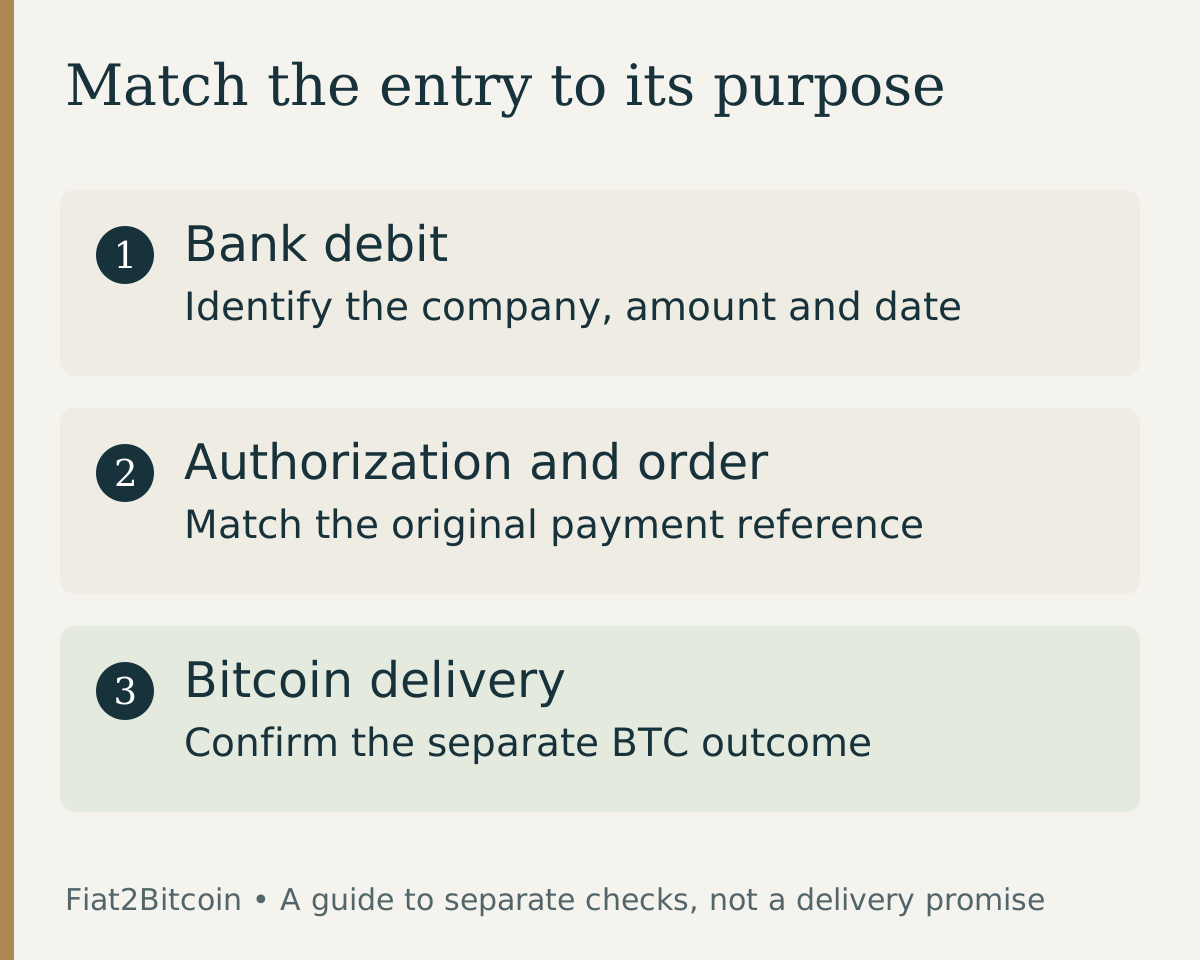
For an ACH-funded purchase, check bank settlement and Bitcoin delivery as separate milestones. The Bitcoin transfer-time guide addresses the network stage rather than the bank entry.
How do you identify an ACH withdrawal on your statement?
Open the transaction details in your bank’s official app or website. Note the displayed company, dollar amount, date, status and any reference. Compare those with your payment confirmation or invoice; a familiar amount alone is not enough to establish a match.
If the name is unfamiliar, ask the bank for the originating company details. The ACH company-ID guide covers identifying an originator, while the trace-number guide covers locating an individual payment. Neither number proves your consent.
Nacha’s consumer FAQ directs individual-payment questions to the bank or initiating organization. Nacha does not hold your transaction history. Check whether another authorized account user approved the debit; if the payment was not authorized, report it to the bank promptly.
Example: a $240 debit and an unfinished Bitcoin order
Imagine a fictional buyer who approved one $240 bank debit for a Bitcoin order. Their bank shows an ACH withdrawal for $240, while the provider’s order record still says review pending. The buyer should compare the company, date and references with the original authorization, then ask the provider what remains before fulfillment.
The matching bank entry does not supply a BTC quantity, a delivery deadline or a Bitcoin transaction ID. If no delivery record exists yet, creating a second order would add another payment attempt without resolving the first. The useful question is what happened to the existing order and its authorized payment.
This example contains no live quote, fee rate, bank instructions or customer transaction. If the bank entry and authorization do not match, investigate the difference rather than assume the debit belongs to that order.
What if the withdrawal is pending, returned or duplicated?
Ask your bank what its displayed status means and ask the collecting company which payment attempt it refers to. A pending bank entry, a posted debit and a provider hold describe different records. There is no universal Bitcoin-delivery deadline encoded in the word withdrawal.
For a returned payment, obtain the exact code and read the ACH return-code guide. For a hold, use the ACH hold guide. Resolve the original record before retrying; a return is not itself confirmation that a purchase was canceled or refunded.
If two similar debits appear, compare their individual references and ask whether the bank is showing one pending and one posted view of the same attempt or two separate payments. Do not dismiss a second charge solely because the amount is familiar.
What should you confirm before an ACH Bitcoin purchase?
Check the selected provider’s actual offer and ACH authorization: the collecting company, account, amount, timing and whether permission is for one payment or a recurring arrangement. A saved bank connection is not a receipt for a new purchase.
Keep the order confirmation alongside the bank record, then confirm the BTC quantity, complete costs, destination and remaining delivery conditions with the provider. Start with the ACH purchase pillar for that broader checklist. The bank entry and the Bitcoin order should be reconcilable without treating either as a substitute for the other.
Sources & further reading
General payment information and purchase-specific details serve different purposes. Review the current offer and terms before proceeding.
- Nacha: How ACH payments work
- Nacha: Consumer FAQs and unfamiliar debits
- CFPB: Stopping automatic bank-account payments
Original Fiat2Bitcoin guide. Examples are illustrative; they are not live quotes or customer transactions. How we prepare our guides.