Where does the heat go?
Braiins’ cooling overview distinguishes air, immersion and hydro designs. In a single-phase immersion system, the cooling liquid remains liquid while transporting heat to a heat exchanger. In a two-phase design, evaporation and condensation are part of the heat-transfer cycle. These are different engineering systems, not interchangeable tanks.
Heat has to leave the mining space. A quiet tank does not eliminate the heat load or the possible noise from pumps, fans and external heat-rejection equipment. Compatibility must cover the actual miner, power supply, materials, fluid and operating conditions.
This article compares decision inputs. It is not an installation procedure, electrical design, fluid recommendation or instruction to modify an air-cooled miner. Check manufacturer requirements and obtain a qualified system design before committing equipment.
A fictional comparison where immersion uses more power
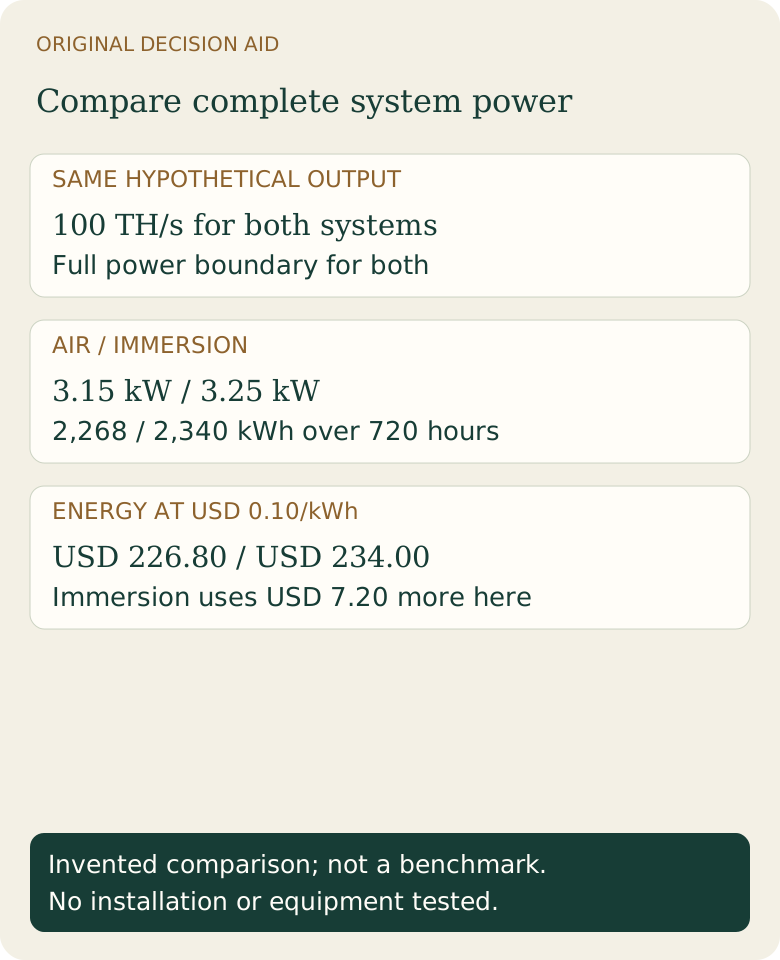
Assume both setups deliver the same measured 100 TH/s. For the air setup, invent 3.00 kW of miner power and 0.15 kW of allocated cooling overhead: 3.15 kW total. For immersion, invent the same 3.00 kW miner draw and 0.25 kW of allocated pumps and heat-rejection overhead: 3.25 kW total.
Over 720 hours, the air example uses 2,268 kWh and immersion uses 2,340 kWh. At an invented USD 0.10/kWh, their energy costs are USD 226.80 and USD 234.00. Immersion costs USD 7.20 more in this example. That result comes from the invented inputs; it is not a benchmark or a claim that immersion always consumes more.
Using the same system boundary, 3,150 W / 100 TH/s = 31.5 J/TH and 3,250 W / 100 TH/s = 32.5 J/TH. Do not compare a chip-only efficiency number with another system’s complete wall measurement.
Scroll across the table to see all columns.
| Input or result | Air example | Immersion example |
|---|---|---|
| Useful measured hash rate | 100 TH/s | 100 TH/s |
| Miner plus allocated auxiliaries | 3.15 kW | 3.25 kW |
| 720-hour energy | 2,268 kWh | 2,340 kWh |
| Energy at USD 0.10/kWh | USD 226.80 | USD 234.00 |
| Whole-system efficiency | 31.5 J/TH | 32.5 J/TH |
Include the tank, pumps and service life
Braiins’ immersion-economics article identifies infrastructure such as tanks, pumps, pipes, heat exchangers, coolant and monitoring. Its historical model is not a current installation quote. The useful question is which costs change in your own design and which assumptions make the comparison work.
Add an invented USD 1,500 incremental installation cost allocated over 24 months: USD 62.50/month. Combined with the fictional USD 7.20 extra energy, that creates a USD 69.70 monthly planning gap before maintenance, downtime, financing or resale. This allocation does not predict the equipment’s service life or cash-flow timing.
If a seller claims higher hash rate, re-run the comparison at that actual power level and with an appropriate measurement interval. A change in speed can alter both revenue exposure and electrical demand. Heat reuse has value only if there is an actual useful heat demand and a way to measure the displaced cost; do not count all produced heat as cash savings.
What should a complete proposal answer?
Ask for a defined measurement boundary, ambient conditions, coolant specifications, approved materials, power-supply placement and heat-rejection capacity. Confirm the procedure for handling leaks, recovering a failed unit, draining and transporting equipment, maintaining fluid quality and disposing of materials.
Warranty and service requirements are device-specific. Get confirmation for the exact model and modification rather than assuming a cooling method extends coverage. Neither a fluid label nor a generic tank specification establishes compatibility with every miner.
Scroll across the table to see all columns.
| Input | Evidence question | Avoid assuming |
|---|---|---|
| Power boundary | Are pumps and external cooling included? | Miner-only watts equal site watts |
| Hash rate | How was sustained useful output measured? | A brief peak is normal output |
| Heat rejection | What happens at the design ambient condition? | A tank alone removes heat |
| Compatibility | Which device, fluid and materials are approved? | Any nonconductive liquid is suitable |
| Maintenance | What are the service and removal steps? | A sealed-looking system is maintenance-free |
Compare operation rather than cooling labels
Use the mining electricity calculator with complete power inputs, then compare a hosted option through the miner hosting guide. The mining basics guide covers the separate question of solo and pool participation.
Download the original cooling comparison. It records the invented inputs, system boundaries and unmodeled costs. Fiat2Bitcoin does not install, test or certify mining systems. For a separate BTC acquisition decision, review purchase methods; acquiring BTC and operating a mine have different costs and risks.
Is immersion cooling the same as hydro cooling?
No. The cooling path and hardware requirements differ. Use the exact manufacturer and system design rather than treating the terms as interchangeable.
Will immersion automatically improve J/TH?
No. Compare useful sustained output and the complete system’s electricity use at the same boundary. Auxiliary equipment and operating mode can change the result.
Were these systems physically tested?
No. All numerical comparisons here are hypothetical calculations, not hardware measurements or installation results.
Sources & further reading
These sources explain the payment systems and rules discussed in this guide. For your purchase, check the provider’s current offer and terms.
- Braiins: air, immersion and hydro cooling
- Braiins: immersion economics and infrastructure assumptions
Original hypothetical system-boundary, energy and capital-allocation calculations. No physical cooling system or hardware was tested. How we prepare our guides.