What does Bitcoin miner hosting include?
You supply or purchase mining hardware and pay a facility to operate it. Before comparing quotes, identify the equipment owner, the facility operator, the party invoicing you and who controls the pool account. A hardware purchase, a hosting contract and a promised share of someone else’s mining output are different arrangements.
Compass Mining’s fee explanation says its hosting fee covers electricity, facility security, customer service and monitoring. Its invoice FAQ also discusses hardware financing and downtime treatment. These are examples of one provider’s published structure, not a universal industry bundle or a recommendation. Read the agreement and order that actually apply to your machine.
For the broader decision about hardware, pool participation and electricity, start with can you still mine Bitcoin?. This guide focuses on comparing a hosting contract rather than choosing a home miner.
Turn the quoted rate into a monthly cost
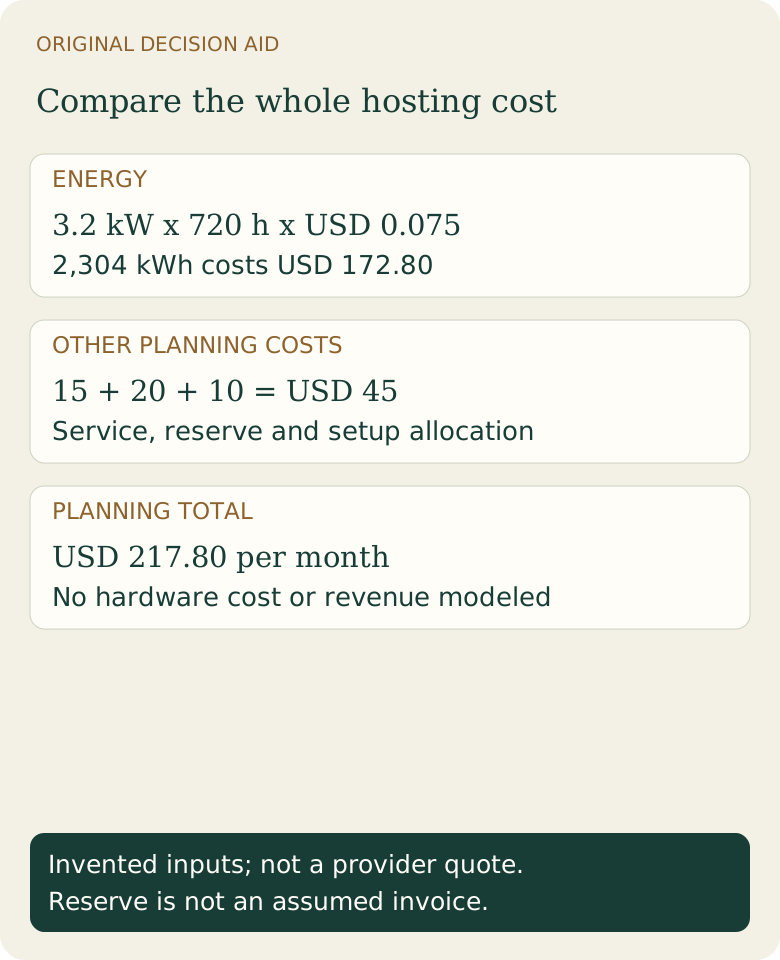
The following numbers are invented to show the arithmetic. Assume a 3.2 kW complete miner, 720 billed hours in a 30-day month and a USD 0.075/kWh energy rate. Energy is 3.2 × 720 = 2,304 kWh; its charge is 2,304 × USD 0.075 = USD 172.80.
Add a hypothetical USD 15 monthly service charge and USD 20 maintenance reserve. Allocate a fictional USD 120 setup charge across 12 months: USD 10/month. The planning total is USD 217.80/month. The reserve is money you set aside, not an assumed invoice; the setup allocation is a comparison convention, not the actual payment schedule.
This is a cost model, not a mining return. It excludes the miner purchase price, financing, taxes, shipping, pool fees and other contract-specific items. Do not subtract it from a vendor’s best-day revenue screenshot and call the result reliable profit.
Scroll across the table to see all columns.
| Item | Calculation | Monthly planning amount |
|---|---|---|
| Energy | 3.2 kW × 720 h × USD 0.075/kWh | USD 172.80 |
| Service fee | Invented flat charge | USD 15.00 |
| Maintenance reserve | Invented budget, not an invoice | USD 20.00 |
| Setup allocation | USD 120 / 12 months | USD 10.00 |
| Planning total | 172.80 + 15 + 20 + 10 | USD 217.80 |
Does downtime actually reduce your bill?
Ask whether the energy line uses measured consumption, rated power, reserved capacity or a fixed monthly amount. Then ask how curtailment, network failures and miner-specific repairs are treated. Facility availability is different from your machine submitting accepted shares.
In the same fictional month, 95% operating time means 684 running hours and 36 offline hours. If energy is billed only for those running hours, 3.2 × 684 × USD 0.075 = USD 164.16, a USD 8.64 reduction from the full-hours energy example. If the contract bills reserved capacity, that reduction may not apply. Lower energy cost during downtime also does not compensate automatically for lost mining output.
Request the credit formula, exclusions, claim process and invoice timing in writing. Do not assume a service-level target is an unconditional reimbursement or a guarantee that your particular machine will achieve that uptime.
Questions to resolve before shipping a miner
Use the same checklist for each quote so a missing answer stays visible. Ask for the exact facility and counterparty, equipment serial-number inventory, insurance scope, repair authorization limit, billing method and contract term. Check whether you can select or inspect the mining pool and change the payout destination through the agreed process.
Read the exit terms before the entry discount. A low rate can be outweighed by a long minimum term, removal charges, shipping restrictions or unclear access to hardware. Confirm how your machine is identified and returned if the facility closes or you end the agreement.
Scroll across the table to see all columns.
| Question | Evidence to obtain | Reason it matters |
|---|---|---|
| What is actually billed? | Signed rate basis and all fee categories | A power rate is not the whole invoice |
| Who controls the hardware? | Ownership, serial numbers and removal terms | A dashboard is not physical access |
| Who controls payouts? | Pool-account and destination permissions | Separate hosting from payout custody |
| Who approves a repair? | Spending limit, quote and downtime rules | Avoid an undefined maintenance bill |
| How do you leave? | Notice, release conditions and shipping costs | Compare the complete contract life |
Compare the same machine and the same assumptions
Compare candidates using identical power draw, hours, fee categories and ownership assumptions. Keep a separate column for unknown charges. If a quote needs an optimistic Bitcoin price or uninterrupted full output to appear affordable, record that dependency rather than hiding it.
Download the original hosting worksheet to reproduce the fictional example and record your own comparison locally. Fiat2Bitcoin does not host miners, sell hardware or guarantee mining payouts. For a separate decision to acquire BTC, review available purchase methods and purchase costs. A provider purchase is not a substitute for evaluating a hosting contract.
Is miner hosting the same as cloud mining?
Not necessarily. Identify whether you own a specific machine and contract for its operation, or purchase a different claim on hash power or output. The names alone do not establish ownership or payout rights.
Does a low hosting rate guarantee profit?
No. Hardware cost, network conditions, actual output, uptime, fees and Bitcoin price can change the result. This guide calculates invented costs without projecting revenue.
Does Fiat2Bitcoin operate a mining facility?
No. This guide is educational; Fiat2Bitcoin does not offer mining hosting or custody mining equipment.
Sources & further reading
These sources explain the payment systems and rules discussed in this guide. For your purchase, check the provider’s current offer and terms.
Original hypothetical cost and downtime calculations; no host inspection, quote acceptance, hardware benchmark or profitability test. How we prepare our guides.