Calculate a hypothetical electricity budget
Check the electricity arithmetic
A zero electricity estimate is not evidence of free mining or profit. Actual production can be zero.
Use the calculator in this section with your own nonsecret figures. Enter whole watts, hours per day and days, plus a tariff in USD per kWh. It runs locally in your browser and uses no mining-pool connection, wallet data or live electricity feed. The default inputs are teaching assumptions.
A nameplate wattage is not necessarily the total measured draw at the wall. Cooling, networking and other equipment can add costs. If your bill has demand charges, tiered prices, taxes or time-of-use periods, one flat tariff will not model it completely.
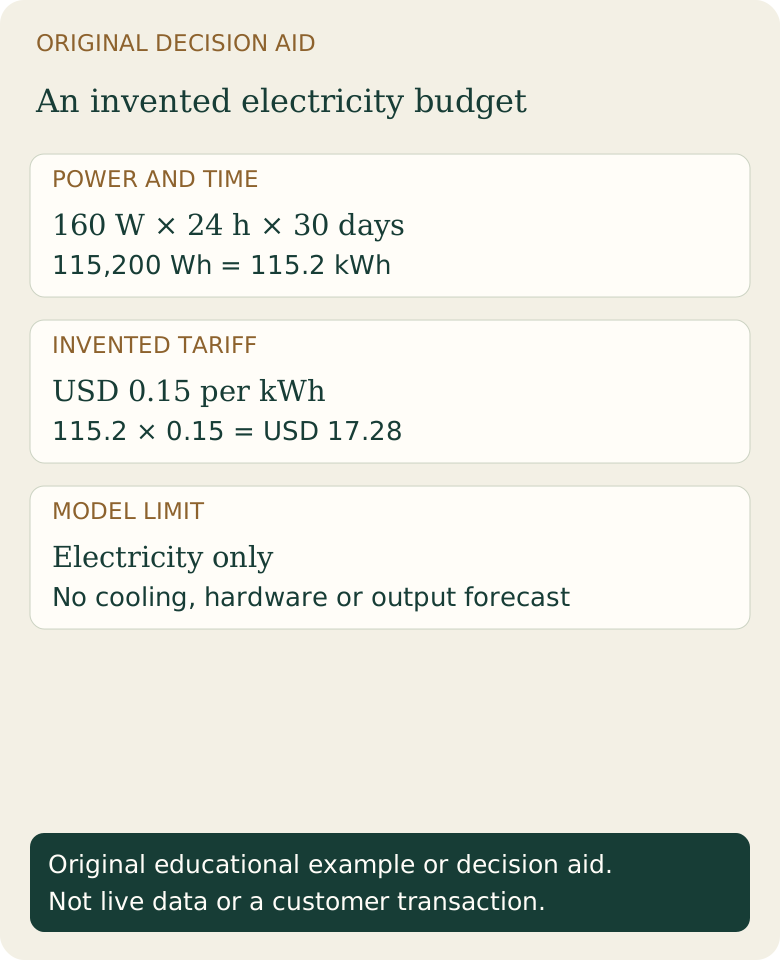
Worked example: a 160-watt device
Invented assumptions: 160 W × 24 hours × 30 days = 115,200 Wh, or 115.2 kWh. At $0.15 per kWh, electricity is $17.28 for the period. This calculation does not validate any device’s advertised power or hash rate.
For comparison, a 3,000 W load on the same schedule uses 2,160 kWh and costs $324.00 at that tariff. Those are energy calculations, not device recommendations. Electrical capacity, ventilation, noise and safe installation need their own assessment before equipment is installed.
Why cost per BTC needs an output assumption
Suppose an invented period has $324 of electricity, $60 of cooling/other operating costs and $90 of allocated hardware cost. Total modeled cost is $474. If the assumed output is 0.003 BTC, the modeled cost is $158,000 per BTC. At half the output, 0.0015 BTC, it doubles to $316,000 per BTC.
Neither output is a prediction. A solo miner can produce no block reward during a period even while consuming power. In that case, dividing costs by zero output does not produce a meaningful finite cost per BTC. Do not replace that result with an expected number and call it realized performance.
Keep assumptions separate from observed results
Scroll across the table to see all columns.
| Input | Stronger evidence | Common shortcut |
|---|---|---|
| Electricity | Measured kWh and actual tariff | A constant advertised wattage |
| BTC received | Confirmed payout records for the period | A calculator’s expected output |
| Other costs | Actual fees, cooling and hardware allocation method | Ignoring them because electricity is visible |
| Comparison period | The same dates for costs and production | Comparing one cheap day with a different payout month |
What should you compare before buying hardware?
Check model-specific documentation, power-supply requirements, purchase and shipping cost, warranty, firmware provenance, noise, cooling and pool terms. Keep TH/s and watts distinct: one describes hash rate and the other power. A cheap unit can still be unsuitable for your space or budget.
For reward uncertainty and small solo miners, read can you still mine Bitcoin?. For a machine that validates blocks without earning mining rewards, see node versus miner. Mining difficulty and future BTC prices can change the comparison; this page supplies no live profitability or investment recommendation.
Sources & further reading
These sources explain the payment systems and rules discussed in this guide. For your purchase, check the provider’s current offer and terms.
Published by Fiat2Bitcoin. Worked examples use fictional figures and records; they are not current prices or customer transactions. How we prepare our guides.