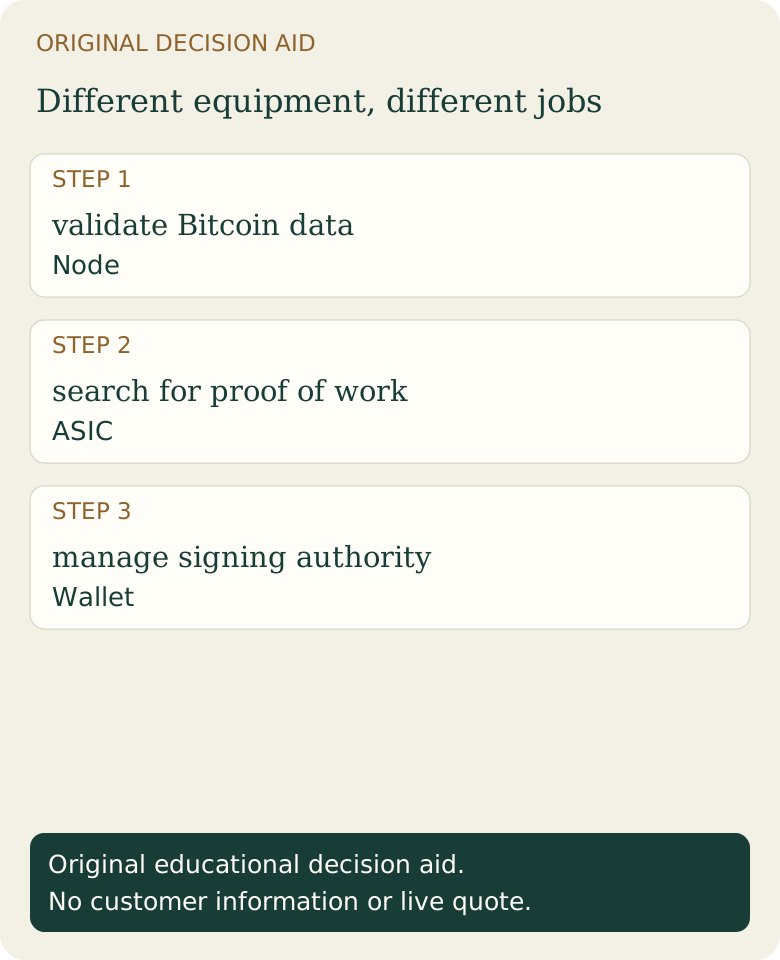
What does each component do?
The Bitcoin developer mining guide explains block construction and proof of work. A node can validate blocks without producing them. A solo-mining setup also needs hashing hardware and a correctly configured path from that hardware to suitable block templates.
Scroll across the table to see all columns.
| Component | Main job | Does it guarantee block revenue? |
|---|---|---|
| Validating Bitcoin node | Check blocks and transactions under its rules | No |
| Wallet | Track keys, create requests and authorize spends | No |
| ASIC miner | Perform specialized proof-of-work hashing | No |
| Pool or solo-mining interface | Coordinate work and submission for the chosen route | No; inspect its actual payout arrangement |
What hardware should you choose for a node?
Read the current Bitcoin Core download guidance and requirements. Storage, initial synchronization, bandwidth and reliable operation matter. The chain grows, so verify current needs rather than buying exactly enough space for an old estimate.
Pruning reduces retained block storage after validation; it is not a way to skip validation or create mining revenue. Wallet rescans and historical-data features may require data a pruned node no longer retains. Select the storage mode for the task, then check the installed version’s documentation.
Original storage-planning example
Assume an entirely hypothetical current data footprint of 700 GB, an invented growth allowance of 10 GB per month for 24 months and an extra 100 GB operating margin. The planning total is 700 + (10 × 24) + 100 = 1,040 GB. These are invented assumptions, not measured chain size, a vendor specification or a current minimum.
Compare the device’s usable capacity with your own measured inputs, other files, backup needs and SSD wear. A product labeled “1 TB” and a filesystem reporting binary units can show different numbers without representing different storage. Leave headroom and revisit the plan rather than treating a single capacity as permanent.
What setup did we actually test?
We ran Bitcoin Core 32.1 on macOS arm64 with a fresh regtest directory, networking disabled and zero peers. A fresh unfunded descriptor wallet was backed up and restored under another name, and the restored wallet recognized its original receiving address. Read the full recovery test and limits.
That test exercised local wallet operations, not mainnet synchronization, block propagation, ASIC connectivity, electricity use or mining profitability. We did not test Windows. A Windows solo-mining guide must additionally match your actual Core release, miner software, authentication and network exposure; a generic “run a node” command is insufficient.
What if the goal is solo mining?
Use the mining economics guide to separate hashrate, electricity, pool terms and the chance of finding a block. Your node’s CPU model is not a substitute for an ASIC’s measured Bitcoin hashrate. Expected value is not a regular payout schedule.
Keep remote administration and RPC authentication private, and follow the current software’s security guidance. No payment, customer account or live mining connection was used for this article. Fiat2Bitcoin does not sell mining equipment or promise mining returns.
Which changing requirement belongs in your plan?
For a node, inspect the current software’s storage, bandwidth and validation requirements rather than treating an old hardware shopping list as permanent. Pruning changes storage use; it does not turn the node into a miner or eliminate all initial synchronization work.
For a miner, budget power and cooling separately from hash-rate and payout assumptions. The mining cost calculator handles energy arithmetic; the difficulty guide explains why a ten-minute network target is not a personal reward schedule.
Sources & further reading
These sources explain the payment systems and rules discussed in this guide. For your purchase, check the provider’s current offer and terms.
- Bitcoin Core: downloads and current requirements
- Bitcoin Core: resource requirements
- Bitcoin developer guide: mining
- Bitcoin Core 32.1 wallet management
- US EIA: Measuring electricity
- Bitcoin Core: Mainnet proof-of-work parameters
Published by Fiat2Bitcoin. Worked examples use fictional figures and records; they are not current prices or customer transactions. How we prepare our guides.