
What does mining difficulty measure?
Miners search for a block hash that meets the network’s target. A harder target makes successful results rarer for a given amount of hashing. Difficulty expresses that target relative to a reference; it is not a count of miners or a price in dollars.
A validating node checks whether blocks satisfy consensus rules. A node does not earn block rewards simply by running. The node-versus-miner guide separates those roles and the hardware needed for each.
Why does the network adjust it?
The mainnet adjustment uses 2,016-block periods and a target timespan corresponding to ten minutes per block. Changes are bounded by consensus rules. That structure aims to keep the long-run block schedule near its target as hash power changes; it does not make each block arrive on a timer.
The next adjustment’s calendar date and value are estimates until the relevant blocks exist. This article does not provide a live difficulty level, a current adjustment countdown or a forecast about the next change. A diagram with a fixed ten-minute schedule would hide the very uncertainty a miner needs to understand.
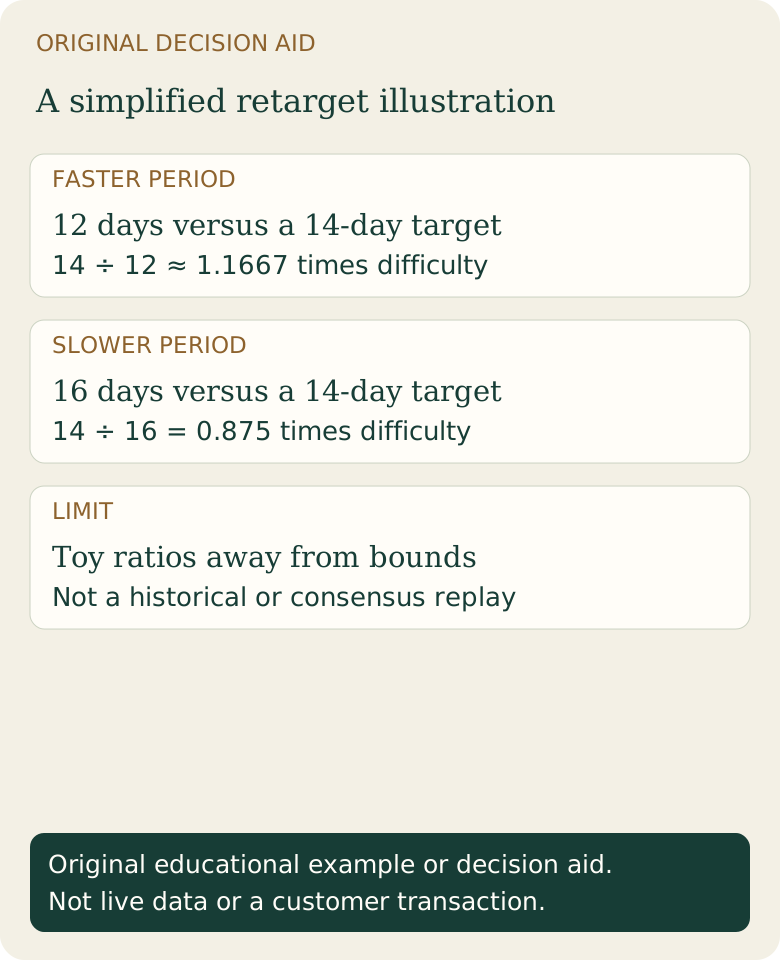
A simplified retarget calculation
Invented example, away from adjustment bounds: suppose one period takes 12 days instead of a target 14. A simplified difficulty comparison is 14 ÷ 12, or about 1.1667 times the previous difficulty: an increase of approximately 16.67%. A 16-day period gives 14 ÷ 16 = 0.875, a decrease of 12.5%.
These examples explain the direction and ratio; they are not an exact consensus implementation. Actual timestamp boundaries, target representation and clamping rules matter. We have not reconstructed a historical retarget or predicted a future one.
Difficulty, hash rate and shares are not interchangeable
Scroll across the table to see all columns.
| Term | What it describes | Avoid this inference |
|---|---|---|
| Network difficulty | Consensus proof-of-work target relative to a reference | Not the same as TH/s on a device listing |
| Network hash rate | An estimate of aggregate hashing activity | Not a directly observed inventory of every miner |
| Pool share difficulty | A pool’s threshold for measuring contributed work | Submitting a share is not necessarily finding a Bitcoin block |
| Personal payout | Result of actual reward and pool arrangements | Not guaranteed by a theoretical expected-value calculation |
What changes in your mining budget?
A device consuming a constant 160 W can use the same energy even while the network target or reward prospects change. At the same tariff and runtime, that electricity expense stays the same in the model; BTC production assumptions need updating separately.
Use the electricity-cost calculator to separate costs from output. Compare current product documentation and the actual pool terms before buying equipment. Our solo-versus-pool guide explains why a small solo miner can produce no reward during an observed period even when a calculator displays a nonzero average.
Sources & further reading
These sources explain the payment systems and rules discussed in this guide. For your purchase, check the provider’s current offer and terms.
- Bitcoin Core: Mainnet proof-of-work parameters
- Bitcoin developer guide: Mining
- US EIA: Measuring electricity
Published by Fiat2Bitcoin. Worked examples use fictional figures and records; they are not current prices or customer transactions. How we prepare our guides.