
What does Nash equilibrium mean for Bitcoin?
Ed Felten’s Princeton analysis explains why beating one opponent strategy does not establish dominance over every alternative. An equilibrium asks a different question: given the other players’ choices, can one player improve their own outcome by changing alone?
In mining, the answer needs a particular model. Specify whether the players are individuals or pools, what actions they can take, what they observe and whether payoffs mean immediate revenue, long-term profit or something else. A conclusion from one model does not automatically cover every real-world miner.
Original example A: when both publishing is stable
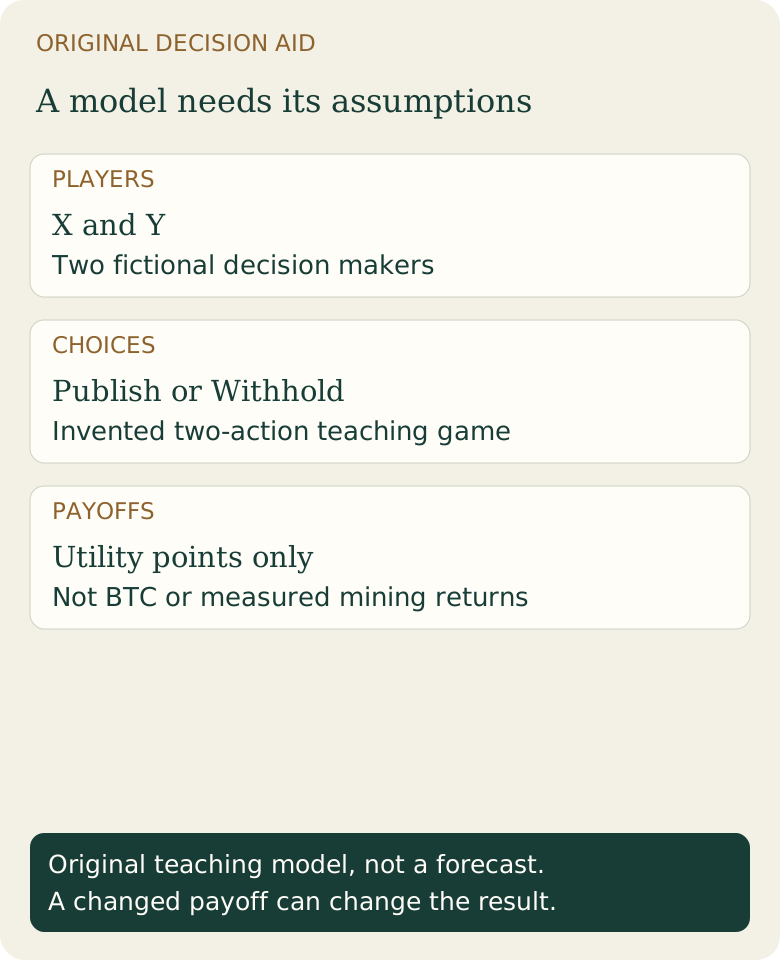
Imagine two fictional players, X and Y, each choosing Publish or Withhold. Each cell lists X’s utility first and Y’s second. The numbers below are invented utility points, not BTC, measured profits, attack probabilities or a simulation of the Bitcoin protocol.
Scroll across the table to see all columns.
| X choice / Y choice | Y publishes | Y withholds |
|---|---|---|
| X publishes | (3, 3) | (2, 2) |
| X withholds | (2, 2) | (1, 1) |
Check each player’s best response
If Y publishes, X gets 3 by publishing and 2 by withholding, so X prefers Publish. If Y withholds, X gets 2 by publishing and 1 by withholding, so X still prefers Publish. By symmetry the same is true for Y. In this invented game, both publishing is a Nash equilibrium: either player changing alone would reduce their own payoff.
The result follows from the chosen numbers. It does not establish that actual Bitcoin mining has those payoffs, that every player is rational or that outside incentives and coordination cannot matter. The teaching contribution is the explicit comparison of alternatives, not a claimed proof about network security.
Original example B: change one payoff assumption
Now change the one-sided withholding payoff to 4 for the player withholding while leaving the other player at 2. Keep the both-publish payoff at (3, 3) and the both-withhold payoff at (1, 1). This is a second invented game, not an estimate of an attack’s profitability.
If both publish, X can now improve from 3 to 4 by withholding while Y continues publishing. Therefore both publishing is not a Nash equilibrium in this second game. No change in terminology repairs that result: the modeled incentive changed. This illustrates why an equilibrium statement must disclose its assumptions.
Scroll across the table to see all columns.
| X choice / Y choice | Y publishes | Y withholds |
|---|---|---|
| X publishes | (3, 3) | (2, 4) |
| X withholds | (4, 2) | (1, 1) |
What do original mining papers actually analyze?
Eyal and Sirer’s selfish-mining paper analyzes deviations in block-publication strategy under its assumptions. Eyal’s Miner’s Dilemma studies a pool-infiltration game and equilibrium outcomes. These are distinct models, not interchangeable evidence for every possible mining strategy.
The papers are historical research, not measurements of today’s pool behavior or a current network-risk score. Read their player definitions, network assumptions and payoff calculations alongside critiques. Our matrices are independent teaching examples and do not reproduce either paper’s model or recommendations.
How should a buyer or small miner use this distinction?
Use the mining guide for equipment and cost arithmetic and the node-versus-miner guide for validation versus hashing. An equilibrium argument does not promise a regular payout, establish a miner’s hardware yield or determine Bitcoin’s future price.
Before repeating “Bitcoin is a Nash equilibrium,” ask: which game, which players, which alternative actions and which payoff horizon? If those are missing, the phrase is an incomplete explanation. This is educational model analysis, not a mining-product endorsement or investment assurance.
Sources & further reading
These sources explain the payment systems and rules discussed in this guide. For your purchase, check the provider’s current offer and terms.
- Princeton CITP: original game-theory analysis
- Eyal and Sirer: original selfish-mining research
- Eyal: The Miner’s Dilemma
Published by Fiat2Bitcoin. Worked examples use fictional figures and records; they are not current prices or customer transactions. How we prepare our guides.