
What activity could produce the money?
Receiving BTC for a genuine service or sale is different from buying BTC in the hope that its price rises. Mining is another activity with equipment, electricity, operating and payout conditions. A third-party yield offer adds its own contract, custody and counterparty risks; do not treat a quoted percentage as money already earned.
Bitcoin.org explains receiving and making payments. The CFTC warns about digital-asset fraud and misleading return claims. Neither a payment method nor the existence of a platform establishes that a customer, mining payout or investment return will materialize.
Scroll across the table to see all columns.
| Activity | What creates the receipt | Costs and evidence to separate |
|---|---|---|
| Work or goods paid in BTC | An actual customer pays an agreed obligation | Work/delivery costs, amount received, fees and records |
| Mining | Accepted work and the pool or network payout rules | Equipment, electricity, downtime, payout thresholds |
| Buying then selling BTC | A later sale converts an asset you bought | Original capital, purchase/sale costs and price change |
| A third-party yield arrangement | The specific contractual or protocol mechanism | Eligibility, access, custody, loss and withdrawal conditions |
Example: a USD 500 service paid in BTC
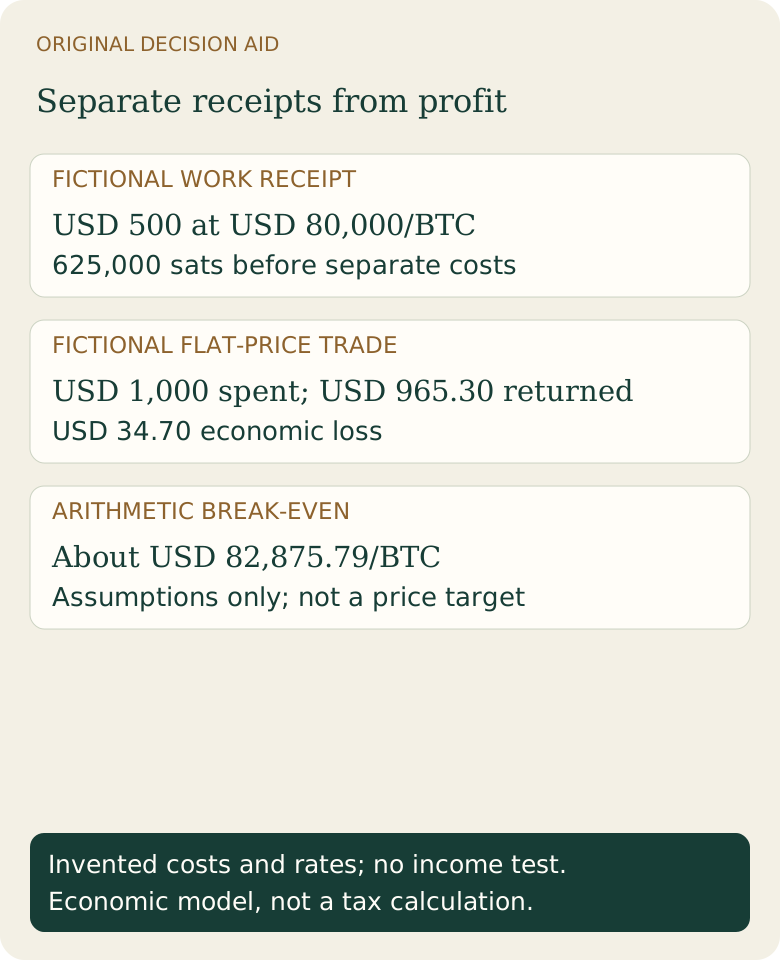
Assume a fictional completed service is priced at USD 500 and the agreed payment quote is USD 80,000/BTC. The BTC amount is 0.00625000, or 625,000 satoshis. Now assume a 2,500-satoshi receiving/withdrawal cost is borne by the worker, leaving 622,500 satoshis. These are invented arrangements, not standard network charges or a Fiat2Bitcoin fee.
At the same reference price, that remaining BTC is worth USD 498 before the worker’s other costs and taxes. If it is later valued at a fictional USD 60,000/BTC, its value is USD 373.50. The work created an obligation to pay; holding the received asset adds a separate price exposure. This example is not a payroll instruction or a tax classification.
Agree the price basis, quote expiry, network, who bears each charge and when the obligation is considered paid. Keep a record of the actual amount and relevant reference. For the receiving question, use the wallet-compatibility guide.
Example: a trade can lose money even at an unchanged BTC price
Invent a USD 1,000 total purchase budget, including a USD 15 acquisition charge. USD 985 buys BTC at an invented USD 80,000/BTC reference: 0.01231250 BTC, or 1,231,250 satoshis. Assume a later sale uses the same BTC price and charges 2% of gross sale proceeds, with no other costs.
Gross sale proceeds are USD 985; the invented 2% charge is USD 19.70. Net sale proceeds are USD 965.30. Compared with the USD 1,000 originally spent, the economic loss is USD 34.70. The USD 965.30 receipt is not all profit because it includes recovered purchase capital.
Scroll across the table to see all columns.
| Step | Calculation | Result |
|---|---|---|
| Total budget | Given, including acquisition charge | USD 1,000.00 |
| BTC purchase amount | USD 985 / USD 80,000 per BTC | 0.01231250 BTC |
| Gross sale at unchanged price | 0.01231250 × USD 80,000 | USD 985.00 |
| Sale charge | 2% × USD 985 | USD 19.70 |
| Net proceeds | USD 985 − USD 19.70 | USD 965.30 |
| Economic result | USD 965.30 − USD 1,000 | −USD 34.70 |
What price would recover the fictional costs?
Under exactly those assumptions, solve 0.01231250 BTC × sale price × 0.98 = USD 1,000. The arithmetic break-even reference is approximately USD 82,875.79/BTC. It is the model’s zero-profit point before tax and excluded costs, not a price target, achievable quote or trading strategy.
If the fee structure, asset quantity or costs change, rework the equation. A spread, withdrawal charge or failed order can change the result. Our purchase-fee guide covers the separate comparison of actual buying costs, and the value calculator explains why a reference valuation is not a net-sale quote.
Where do mining and records fit?
For mining, use the solo-versus-pool guide and electricity calculator. A small miner’s hash rate does not create a deadline for a successful block. Do not turn a vendor’s projected gross payout into personal net income without costs and uncertainty.
The IRS digital-asset guidance addresses reporting and records for US taxpayers. Your tax treatment depends on the activity, account and jurisdiction; the economic comparisons here do not calculate taxable income or a liability. Keep acquisition, payment, fee and sale records rather than relying on a wallet’s current display.
Download the original beginner cash-flow worksheet for the invented inputs and exact arithmetic. Fiat2Bitcoin does not offer jobs, mining payouts, yield programs or guaranteed returns. If you separately choose to acquire BTC, review purchase methods; buying BTC does not create an earning opportunity.
Sources & further reading
These sources explain the payment systems and rules discussed in this guide. For your purchase, check the provider’s current offer and terms.
- Bitcoin.org: individual payments and receiving BTC
- CFTC: digital-asset fraud and return claims
- IRS: digital-asset reporting and records
Original hypothetical paid-work and flat-price trading calculations. No job, customer receipt, mining performance, trade, yield product, tax determination or earning strategy was tested. How we prepare our guides.