A small miner can be an interesting hardware project. The buying mistake is to read a maximum hash rate as an income statement. Two listings can use similar names while describing different ASICs, firmware, cooling or measurement conditions.
This comparison combines the NerdQAxe and Lucky Miner search questions into one decision aid. It adds model/evidence and probability detail to the mining setup guide, rather than duplicating its full installation sequence.
Watch the short explanation
A 72-second educational walkthrough. Match the exact model and documentation. Separate electricity from random rewards. Read pool terms before expecting a payout. Narration is synthetic.
Read the video transcript
Compare the actual model
NerdQAxe and Lucky Miner refer to different hardware and model families. Match the exact board, ASIC, firmware and supply. This documentation review does not establish how every seller’s unit performs or whether that seller is authorized.
An invented running cost
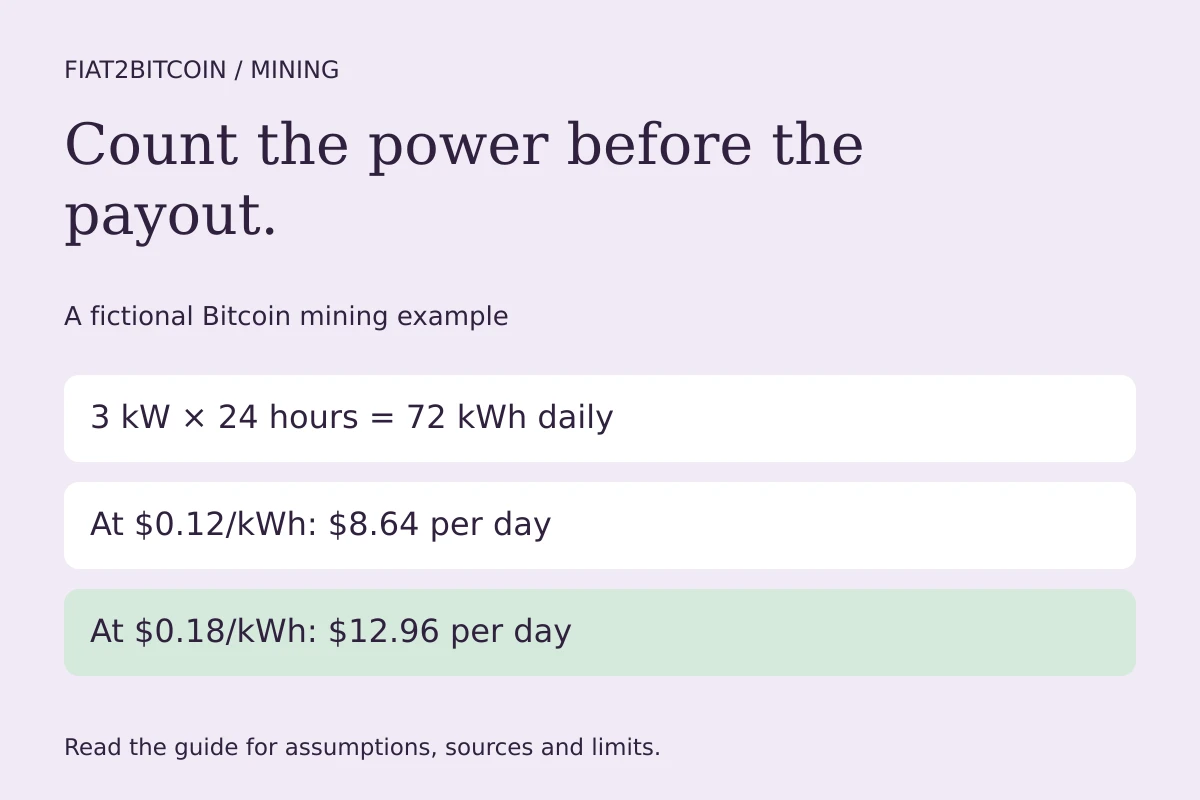
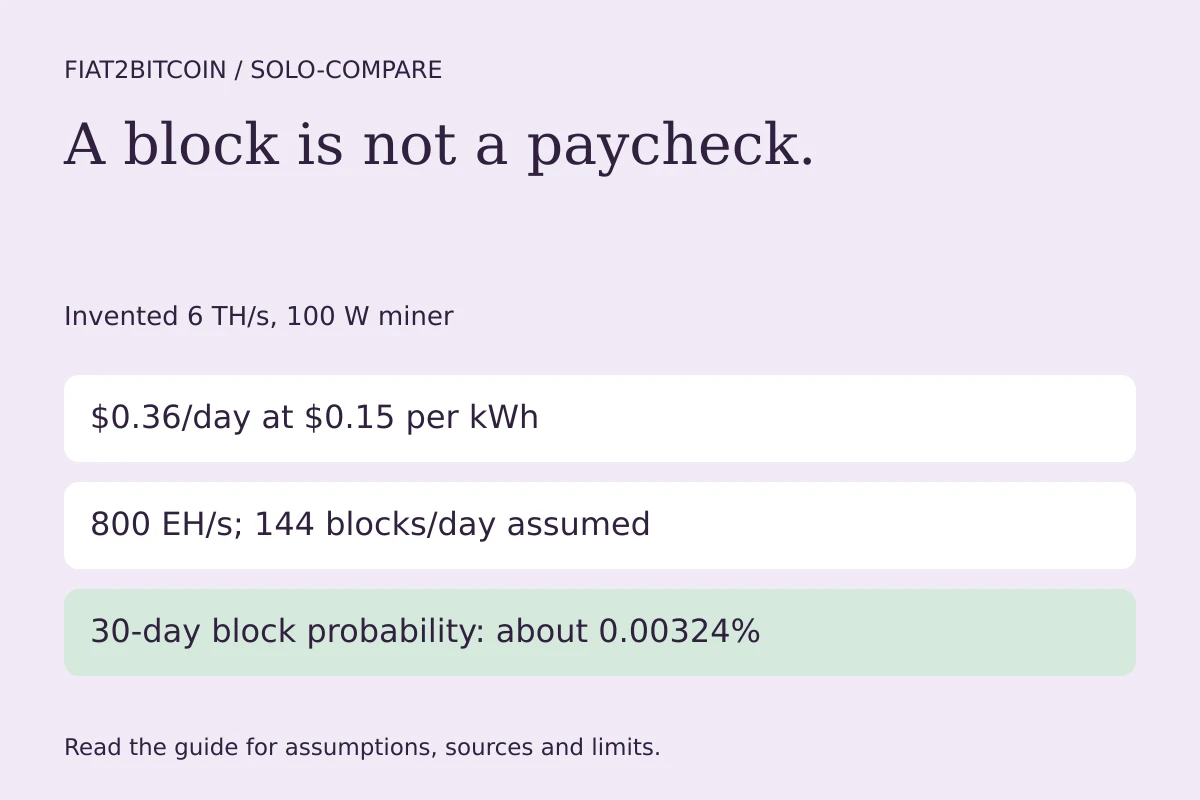
Our invented six terahash miner draws one hundred watts. Running continuously uses two point four kilowatt hours daily. At fifteen cents per kilowatt hour, that is thirty six cents per day, before hardware, cooling and other expenses.
State the network assumption
For the fictional network of eight hundred exahash per second and one hundred forty four blocks per day, this miner’s expected blocks per day are just zero point zero zero zero zero zero one zero eight. These are assumptions, not live network data.
A probability is not a deadline
Under an independent arrival approximation, the chance of at least one block in thirty days is about zero point zero zero three two four percent. Expected waiting time is not a countdown. Real difficulty, uptime and reward terms can change the outcome.
Read what the dashboard means
An accepted pool share need not meet the network block target. Check the service’s actual reward method, fees and payout rules. Treat small solo mining as a hardware and operating decision without relying on a promised block reward.
What do the project and seller documents actually establish?

The NerdQAxe+ project README describes a standalone four-BM1368 design and points to its firmware variant. In its QAxe+ discussion it reports an average 2.4 TH/s at 55 W measured at 230 V. That is a dated project-reported result for the described hardware, not an independent test of every product sold under a similar name.
The linked LV07 manual, version 1.0 dated June 2024 lists a typical 1,000 GH/s hash rate with a 10% tolerance and 25 W power at 25°C with a 10% tolerance. Its 60 W adapter-output requirement is a supply specification, not a claim that the miner continuously consumes 60 W. The project-reported NerdQAxe-family measurement and this seller-manual specification use different conditions; they are not a controlled head-to-head benchmark.
LuckyMinerClub lists model-specific resources for LV07, LV08 and other units. Those are that site’s published materials. This review has not authenticated every seller or tested a Lucky Miner. Its resource page also labels direct retail checkout closed; do not infer current stock or a seller relationship from a download link.
Scroll across the table to see all columns.
| Item | NerdQAxe-family listing | Lucky Miner listing |
|---|---|---|
| Identity to record | Board revision, ASIC and firmware target | Exact model suffix and seller |
| Primary material examined | Project README and linked firmware | Seller’s model resource listing |
| Published numbers examined | QAxe+ project discussion: 2.4 TH/s and 55 W at 230 V | LV07 manual: 1,000 GH/s ±10%; 25 W ±10% at 25°C |
| Performance evidence required | Hash rate, wall draw, voltage and conditions | Same fields for that exact unit |
| What this review does not establish | Your delivered unit’s result or seller authorization | Independent performance, stock or seller authorization |
Compare electricity with explicit invented inputs
The next two machines are invented, not substitutes for the published products. Assume A runs at 6 TH/s and 100 W, B at 1 TH/s and 25 W, continuously, with electricity at $0.15/kWh. Include the power supply and fan in a real wall measurement.
Scroll across the table to see all columns.
| Input / result | Invented A | Invented B |
|---|---|---|
| Hash rate | 6 TH/s | 1 TH/s |
| Wall draw | 100 W | 25 W |
| Daily energy | 2.4 kWh | 0.6 kWh |
| Daily electricity | $0.36 | $0.09 |
| 30-day electricity | $10.80 | $2.70 |
Why even a higher hash rate can still mean no block
For an illustrative constant network of 800 EH/s producing an average 144 blocks per day, A’s share is 6 TH/s ÷ 800 EH/s = 0.0000000075. Multiply by 144 to obtain an expected 0.00000108 blocks per day. This is a model assumption, not today’s network measurement.
Using an independent-arrival approximation, the probability of at least one block in 30 days is 1 − exp(−0.00000108 × 30), about 0.00324%. The expected waiting time is about 925,926 days, but a random outcome has no deadline. Difficulty, hash rate, uptime, valid submissions and pool terms change real outcomes.
Download the invented inputs and probability formula. The example predicts no actual device’s payout and does not include fees or a BTC price.
Accepted shares are not a block reward
A mining share demonstrates work meeting a pool’s assigned target. It need not meet the network’s block target. Solo-pool reward eligibility, deductions and payout routing depend on that pool’s terms and on a valid accepted block.
For proportional or other pooled rewards, read the actual accounting method, fees, thresholds and payout schedule. Do not compare a solo service’s possible jackpot with a pooled service’s accrual as though both are daily wallet income.
A practical pre-purchase record
Ask for information that can be checked for the delivered unit. A small power draw does not remove electrical, heat or firmware risks. Use the exact manufacturer requirements and a qualified electrical assessment where necessary.
- Record the exact board/model, ASIC, firmware source and seller.
- Separate advertised maximum hash rate from a sustained measurement.
- Record voltage, complete wall draw, noise, cooling and supply requirements.
- Read the chosen pool’s reward, fee and payout terms.
- Set a learning/hardware budget that does not depend on finding a block.
Small solo-miner questions
Which one is more profitable?
This documentation review has no comparable live device tests, actual purchase prices or sustained payout measurements. The invented cost/odds example cannot establish a winner.
Does a display showing BTC mean I earned it?
A display can show estimates or pool records. Reconcile the actual reward method and confirmed wallet payout.
Will running it longer eventually guarantee a block?
No fixed operating time guarantees a block. Expected waiting time is not a countdown.
Are the named products all the same revision?
No. Match the exact listing and documentation; the shared family name is insufficient.
Sources & further reading
These primary sources support the explanations and examples above. Check each record’s date and context when following a claim.
- NerdQAxe+ project: Board family and published measurements
- LuckyMinerClub: Its model-specific resource listing
- LuckyMinerClub LV07 manual, June 2024 v1.0
- Bitcoin Developer Guide: Solo and pooled mining
Sources checked November 24, 2026. Published project claims are attributed. The calculation uses invented machines and network conditions, not current quotes or a profit forecast. How we prepare our guides.
Plan the installation before buying hardware.
Follow the installation, cooling, pool-configuration and operating-record sequence before powering equipment.
Read the full mining setup guide