Which manufacturer figures are being compared?
BITMAIN’s S21 XP reference manual identifies a version 10 configuration at typical 270 TH/s and 3,645 W at 25°C inlet conditions. Its S21 Pro specification identifies version 10 at typical 234 TH/s and 3,510 W at 25°C. Dividing power by hash rate gives 13.5 and 15 J/TH respectively.
These are manufacturer reference figures, not measurements made by Fiat2Bitcoin, current inventory checks or proof of sustained site performance. The published notes describe tolerances, including hash-rate variation of ±3% and power/efficiency variation of ±5%. Match the exact unit, mode and operating conditions before using a seller’s listing.
Scroll across the table to see all columns.
| Reference configuration | Typical hash rate | Typical wall power at 25°C | Derived efficiency |
|---|---|---|---|
| S21 XP version 10 | 270 TH/s | 3,645 W | 13.5 J/TH |
| S21 Pro version 10 | 234 TH/s | 3,510 W | 15 J/TH |
Why compare 13 units with 15 units?
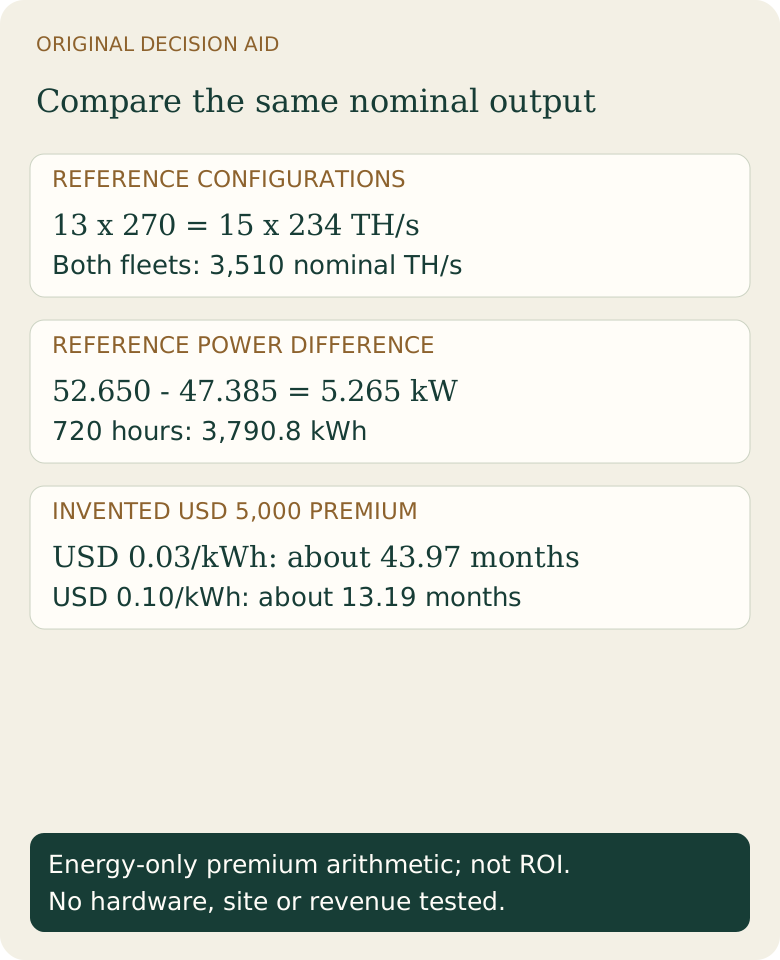
One S21 XP and one S21 Pro do not provide equal nominal hash rate, so comparing only their total power would hide the throughput difference. An original integer-fleet normalization uses 13 × 270 = 3,510 TH/s and 15 × 234 = 3,510 TH/s. Both equal 3.51 PH/s nominally.
At the published reference inputs, the first fleet draws 13 × 3,645 = 47,385 W and the second 15 × 3,510 = 52,650 W. The difference is 5,265 W, or 5.265 kW. Over a fictional 720-hour month, the arithmetic energy difference is 3,790.8 kWh.
This normalization is not a deployment plan. It assumes every unit runs for the same hours at those reference inputs. Actual output, tolerances, ambient conditions, downtime and site auxiliaries can change the comparison. Neither matching nominal TH/s nor matching a model name proves equal accepted mining work.
Scroll across the table to see all columns.
| Quantity | S21 XP reference fleet | S21 Pro reference fleet |
|---|---|---|
| Number of reference units | 13 | 15 |
| Nominal fleet hash rate | 3,510 TH/s | 3,510 TH/s |
| Reference fleet wall power | 47.385 kW | 52.650 kW |
| 720-hour energy | 34,117.2 kWh | 37,908.0 kWh |
How much is that power difference worth?
At an invented USD 0.03/kWh flat rate, 3,790.8 kWh costs USD 113.724; displayed to cents, USD 113.72. At an invented USD 0.10/kWh, it costs USD 379.08. Cheap power reduces the dollar value of the same efficiency difference. It does not make inefficiency free or establish that either fleet is profitable.
Now invent a USD 5,000 higher acquisition cost for the XP fleet, with every other cost and output assumption held equal. Dividing that premium by the unrounded monthly energy difference gives about 43.97 months at USD 0.03/kWh and 13.19 months at USD 0.10/kWh. This is an energy-only premium comparison, not mining ROI, a vendor payback promise or a forecast of hardware life.
Scroll across the table to see all columns.
| Flat energy price | Modeled monthly energy-cost difference | Premium / unrounded monthly difference |
|---|---|---|
| USD 0.03/kWh | USD 113.72, rounded from USD 113.724 | 43.97 months |
| USD 0.10/kWh | USD 379.08 | 13.19 months |
What can reverse an apparent bargain?
Verify the real landed purchase price, taxes, shipping, warranty, availability, repair route and downtime terms. Site electrical, cooling, noise, network and environmental requirements require a qualified assessment of the actual installation. This guide does not size circuits or approve a site from a manufacturer’s nominal wattage.
Demand charges, time-varying tariffs, hosting markup, cooling equipment and curtailed hours can defeat a simple flat-rate calculation. Compare the hosting contract worksheet and whole-system immersion analysis if those affect your proposed setup.
Keep revenue assumptions separate. The two reference fleets are normalized on nominal output only; network difficulty, fees, pool arrangements and BTC price are not modeled here. Our mining basics guide owns the separate solo/pool and small-miner questions.
Use the comparison with your actual evidence
Download the original matched-fleet worksheet to reproduce the source figures and invented cost scenarios. Replace assumptions only with documented inputs, keep their dates and units, and mark unknown costs instead of assigning them zero.
Fiat2Bitcoin does not sell, install or test mining hardware or guarantee payouts. A separate BTC purchase has different costs and responsibilities; buying BTC is not evidence that a mine can earn a return.
Sources & further reading
These sources explain the payment systems and rules discussed in this guide. For your purchase, check the provider’s current offer and terms.
- BITMAIN: S21 XP version 10 reference manual, printed page 3 and notes on page 4
- BITMAIN: S21 Pro version 10 specification
Original analysis of published reference configurations, equal-nominal-output fleets and hypothetical tariffs/premium. No hardware, site, seller, sustained output, current price, mining revenue or ROI was tested. How we prepare our guides.