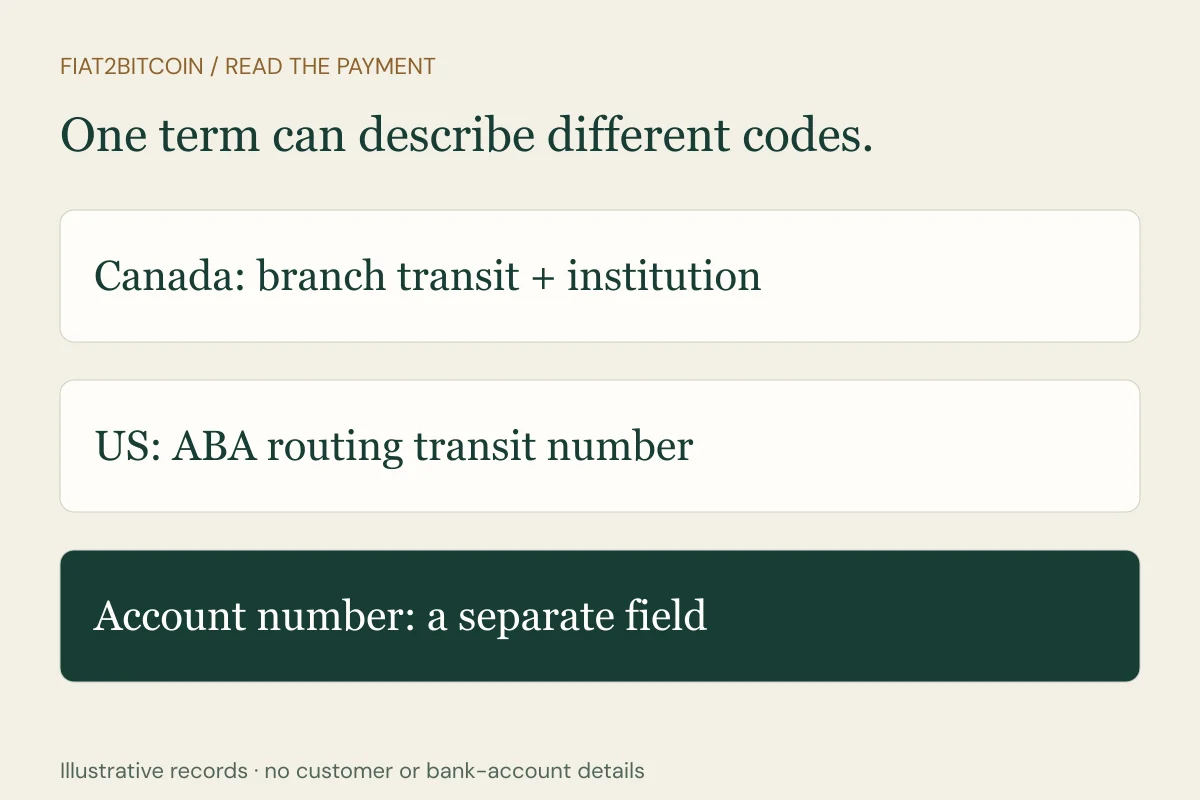
Your recipient supplies a transit number, but the sending form demands a routing number of a different length. The first question is which banking system the form is using. A Canadian branch identifier and a US ABA routing transit number can share part of their name while describing different details.
What is a transit number in Canada?
In Canadian account details, the branch transit identifies the branch where the receiving account is located. Payments Canada’s wire guide distinguishes the five-digit branch transit from the three-digit financial institution number and the beneficiary’s account details. Keep all three roles visible when reading a payment request.
The institution number identifies the institution; the account number identifies the receiving account in its context. A branch address is another descriptive field. Do not infer a current transit number from the address of the nearest branch, a card number or an old saved recipient.
TD’s account-management guidance likewise lists branch transit, institution and account numbers as separate information that a company may need. Use your own account’s authenticated details or a current bank-issued form to obtain the complete values.
Is a transit number the same as a routing number?
For a US account, routing transit number or RTN commonly refers to the nine-digit ABA routing number. The American Bankers Association explains the US routing system and its payment attributes. Use the receiving bank’s instructions for the actual ACH, wire or other supported route.
For a Canadian account, the five-digit branch transit is only part of the routing information. A generic international form can use “routing number” for a combined destination identifier rather than for the branch component alone. The same label does not make a Canadian detail interchangeable with a US ABA number.
The ABA-versus-SWIFT guide covers the US bank-code distinction. Use national clearing code when the form applies a general country-dependent bank-code label.
Scroll across the table to see all columns.
| Context | Field to identify | Keep separate |
|---|---|---|
| Canadian branch | Five-digit branch transit | Institution number and customer account |
| Canadian institution | Three-digit institution number | Branch transit and customer account |
| Canadian electronic routing | Complete bank-specified electronic identifier | The branch component by itself |
| US bank routing | Nine-digit ABA RTN for the selected route | Receiving account number |
Why can Canadian routing information appear in different formats?
Payments Canada’s branch directory distinguishes electronic-payment routing from MICR paper-item formatting. Changing punctuation or reversing digit groups is not a safe way to guess the format a sending service expects. Obtain the complete required value from the bank or its verified instructions.
Payments Canada Rule F8 defines an electronic Direct Payment Routing Number as nine digits, including a leading zero. For an institution allocated an institution number, it describes that number with a leading zero plus the five-digit branch number; it also provides another allocation case. This explains why a bare branch transit can be too short for an electronic-routing field.
Use the existing verified identifier, not a value constructed from this explanation. An electronic Canadian number is not a US ABA number merely because both contain nine digits. Ask the sending service which country-specific identifier its field accepts and how it handles leading zeros.
A fictional example: a five-digit branch detail meets a nine-digit field
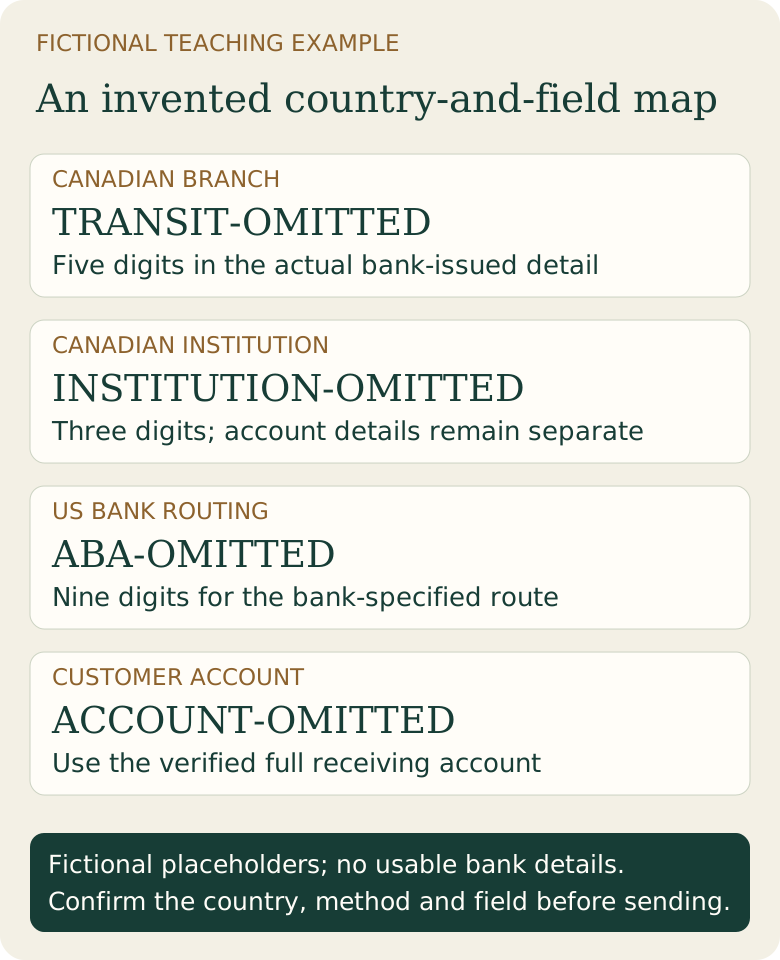
Alex Example is arranging a payment to a Canadian recipient. The verified record contains TRANSIT-OMITTED, INSTITUTION-OMITTED and ACCOUNT-OMITTED. The form has a single “routing number” box. Those placeholders deliberately contain no usable numbers.
Before entering anything, Alex checks the receiving-country selection and the transfer method. If the field is for a Canadian electronic routing identifier, Alex requests that complete bank-issued detail and the required format. If it is a US ABA-only field, Alex asks whether the service supports a Canadian destination through another setup.
The correct next step is to resolve the supported route and field meaning. Padding the branch transit to nine digits, substituting a US bank’s code or placing the account number in the routing box can misdirect or reject the payment. A successful format check alone still does not verify the intended recipient.
Where can you find or confirm the transit and institution numbers?
For your own account, use the signed-in bank account-details screen, an official statement or a current bank-issued direct-deposit form. Preserve all required digits and ask the bank about any abbreviated display. The account’s full receiving details control what you should share through a verified channel.
The official Payments Canada directory can help confirm branch-routing information. It does not identify a private customer’s account owner or prove an invoice is legitimate. No directory results, actual codes or customer records are reproduced here, and this page does not provide a live lookup.
If the receiving instructions differ from an old record, verify the change with the institution or an established recipient contact. If payment was already sent, contact the sending institution with its official receipt and ask which event it has confirmed before sending a replacement.
Does correct bank routing establish final credit to the customer?
A bank-routing identifier, the beneficiary account number and an invoice or final-customer reference serve different roles. Where verified instructions require further credit, ask the sender how it carries that detail to the recipient. Routing to an account does not itself allocate funds to a particular customer.
For a Bitcoin purchase, bank payment, order matching and crypto delivery remain separate. Fiat2Bitcoin does not receive purchase funds or issue bank instructions. Review current purchase methods; the provider and options actually shown in checkout determine the available route. This terminology guide does not establish Canadian bank-payment eligibility.
Sources & further reading
These sources explain the payment systems and rules discussed in this guide. For your purchase, check the provider’s current offer and terms.
- Payments Canada: Wire receiving details and branch/institution roles
- Payments Canada: Electronic and paper routing-format directory
- Payments Canada Rule F8: Electronic DPRN definition and composition
- American Bankers Association: US routing-number system
- TD Canada Trust: Separate branch transit, institution and account details
Published by Fiat2Bitcoin. Worked examples use fictional figures and records; they are not current prices or customer transactions. How we prepare our guides.