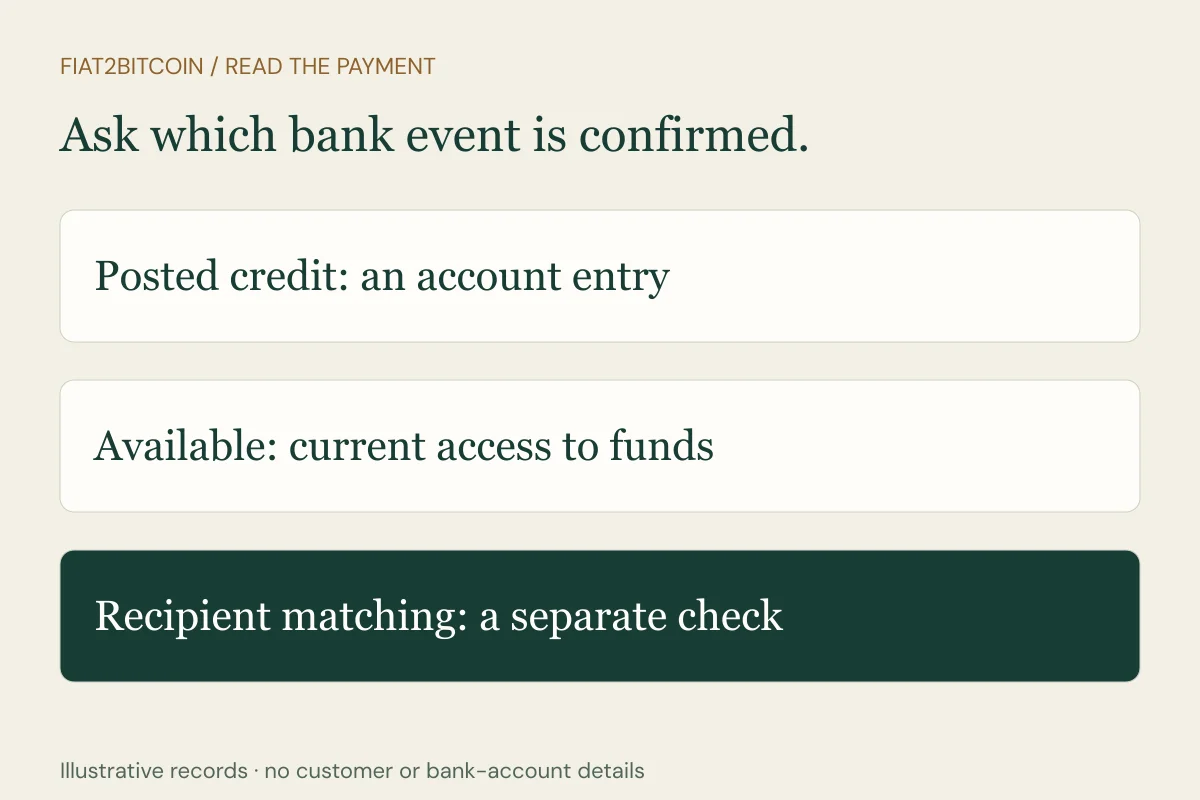
A sender says the money has “cleared,” your bank app shows it as available, and a business is still waiting to match the payment. Those statements can refer to different records. Start with the account entry, payment method and exact question you need answered instead of treating one label as confirmation of every stage.
What does cleared funds mean in banking?
ANZ’s consumer glossary uses cleared funds for money in an account that is available to use. Qudos Bank’s glossary describes verified deposits available for use. These are institution explanations of a banking term; the actual account agreement and payment type determine its application.
Ask whether the bank is reporting an available balance, the removal of a deposit hold, receipt of a payment or another event. Keep the answer attached to the specific entry and time. “Cleared” in budgeting software can also mean a transaction has been matched or checked; that software label does not establish the bank’s legal payment status.
This guide concerns bank-deposit and payment evidence. Brokerage “cleared cash,” securities settlement, property-completion terms and merchant payout reserves can have their own definitions and restrictions. Ask the responsible institution about those products rather than applying a general bank definition.
How do cleared funds differ from current and available balance?
Current or ledger balance describes the entries the bank has posted. Available balance describes the money currently accessible under its calculation, including applicable holds and pending activity. “Cleared funds” is another label whose scope you should confirm; it should not replace the bank’s breakdown.
The current-versus-available-balance guide owns budgeting and avoiding double-counted pending payments. The ACH-hold guide follows an identified hold. Here, the task is to determine what evidence a released hold or credited amount actually gives you.
A dated proof-of-funds document can report a balance or other facts at a stated time. It does not automatically promise that every underlying credit is irrevocable or that a future purchase will be accepted.
Original example: an available credit is later reversed
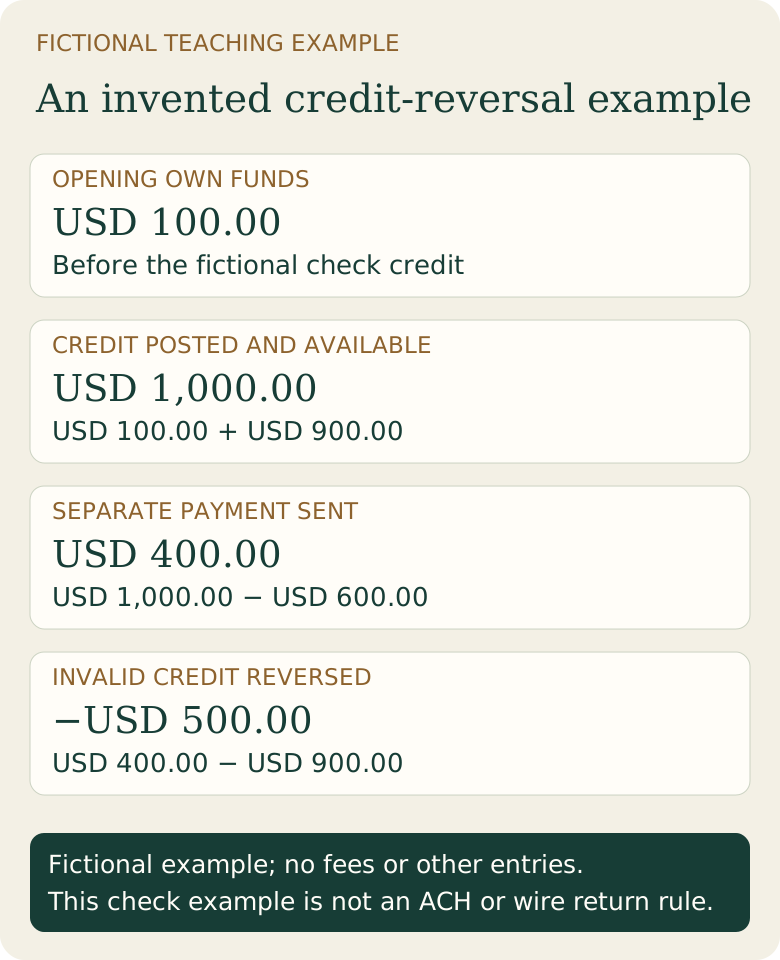
Assume a fictional account starts with USD 100.00. A USD 900.00 check credit is posted and made available. The account holder then sends USD 600.00. Later the bank determines the check is invalid and reverses the USD 900.00 credit. The example excludes fees, interest, overdraft arrangements and all other entries.
The arithmetic is USD 100.00 + USD 900.00 = USD 1,000.00; USD 1,000.00 − USD 600.00 = USD 400.00; USD 400.00 − USD 900.00 = −USD 500.00. The separate outgoing payment did not disappear when the incoming credit was reversed. These are teaching amounts, not a bank policy or actual customer incident.
The FTC’s fake-check guidance explains the underlying risk: funds can be available before a counterfeit check is discovered. That is why an available-balance display does not, by itself, establish that an unfamiliar check is genuine. This check example is not a description of ACH or wire return rules.
Scroll across the table to see all columns.
| Event | Calculation | Resulting balance |
|---|---|---|
| Opening own funds | Starting amount | USD 100.00 |
| Credit posted and available | USD 100.00 + USD 900.00 | USD 1,000.00 |
| Separate payment sent | USD 1,000.00 − USD 600.00 | USD 400.00 |
| Invalid credit reversed | USD 400.00 − USD 900.00 | −USD 500.00 |
What should you ask when a bank says funds have cleared?
Identify the entry by its official reference, date, amount and currency through the institution’s secure channel. Ask: “Which event is confirmed for this entry? Is the amount available now? Does a hold or restriction remain? Can this particular credit still be returned or adjusted, and which terms apply?”
If a recipient is waiting for payment, ask it separately whether its receiving account was credited and whether it matched the invoice, order or final customer. A sender’s debit or released hold does not answer that receiving-side question. The inward-remittance guide explains incoming credit and allocation.
For an ACH return, obtain the actual reason code and time of the attempted debit. The R09 guide addresses a sufficient ledger balance with uncollected funds. Do not diagnose a return or promise a retry from the word cleared alone.
How long does it take for funds to clear?
There is no one timeline for every method, account, country or deposit. Ask about the actual receiving event, availability date, cutoff and restriction. A weekend, review, missing detail or institution-specific process can affect different stages. A calendar estimate should identify what it estimates.
The CFPB’s ATM-deposit explanation illustrates that depositing a check does not require immediate withdrawal availability and that timing depends on the institution and circumstances. That is a US check-deposit example, not a promised schedule for ACH, wires, brokerage cash or Bitcoin delivery.
If an advertised date passes, contact the bank or payment provider with the existing reference and ask for the current status and next update. Confirm that payment before considering another.
What if someone asks you to forward money after a check clears?
The FTC warns about fake checks followed by instructions to send money onward, including cryptocurrency, wires or gift cards. Pause the onward payment and contact your bank’s fraud team through a verified channel. A released hold or plausible-looking check is not a reason to follow that instruction.
If money has already been sent, report the issue promptly to the bank and the service used for the outgoing payment. Keep the official records and ask what recovery process is available; do not assume recovery is guaranteed. The scam-safety guide explains related warning signs.
What does a cleared bank entry establish for a Bitcoin purchase?
A bank entry and a provider order answer different questions. A provider can have separate steps for receiving payment, matching it, verification and wallet delivery. Obtain the provider’s confirmation for the particular order; the bank’s status is not a blockchain transaction ID.
Fiat2Bitcoin does not receive purchase funds, issue bank instructions or hold customer funds or crypto. The provider named in checkout handles verification, payment, delivery and refunds. For a self-directed purchase using your own funds, compare current methods and read the actual provider offer and terms.
Sources & further reading
These sources explain the payment systems and rules discussed in this guide. For your purchase, check the provider’s current offer and terms.
- ANZ: Consumer glossary definition of cleared funds
- Qudos Bank: Institution glossary and availability terminology
- FTC: Fake-check availability and onward-payment risk
- CFPB: Check deposits at ATMs and availability limits
Published by Fiat2Bitcoin. Worked examples use fictional figures and records; they are not current prices or customer transactions. How we prepare our guides.