You have an Australian recipient’s BSB and account number, but the sender asks for a routing code, SWIFT or IBAN. Start by confirming the receiving country, currency and transfer method. A familiar six-digit shape is not enough to identify the payment system or the correct recipient.
What is a BSB number in banking?
ASIC’s Moneysmart glossary defines BSB as a six-digit Australian bank/branch identifier and explains that the BSB plus account number identifies a particular account. BSB expands to Bank State Branch. It commonly appears in a three-digit, hyphen, three-digit layout, while some forms request the six digits without punctuation.
ANZ’s glossary treats BSB and account number as a payment type in its banking service and explains where its customers can see the BSB in account details. Use the recipient’s current record rather than guessing from a branch name. A bank’s online display can differ from the sending service’s required formatting.
The national-clearing-code guide explains generic bank-code labels. For an Australian account, ask the sending service whether its NCC or bank-code field expects the BSB, another identifier or a different supported route.
Is a BSB the same as an account number?
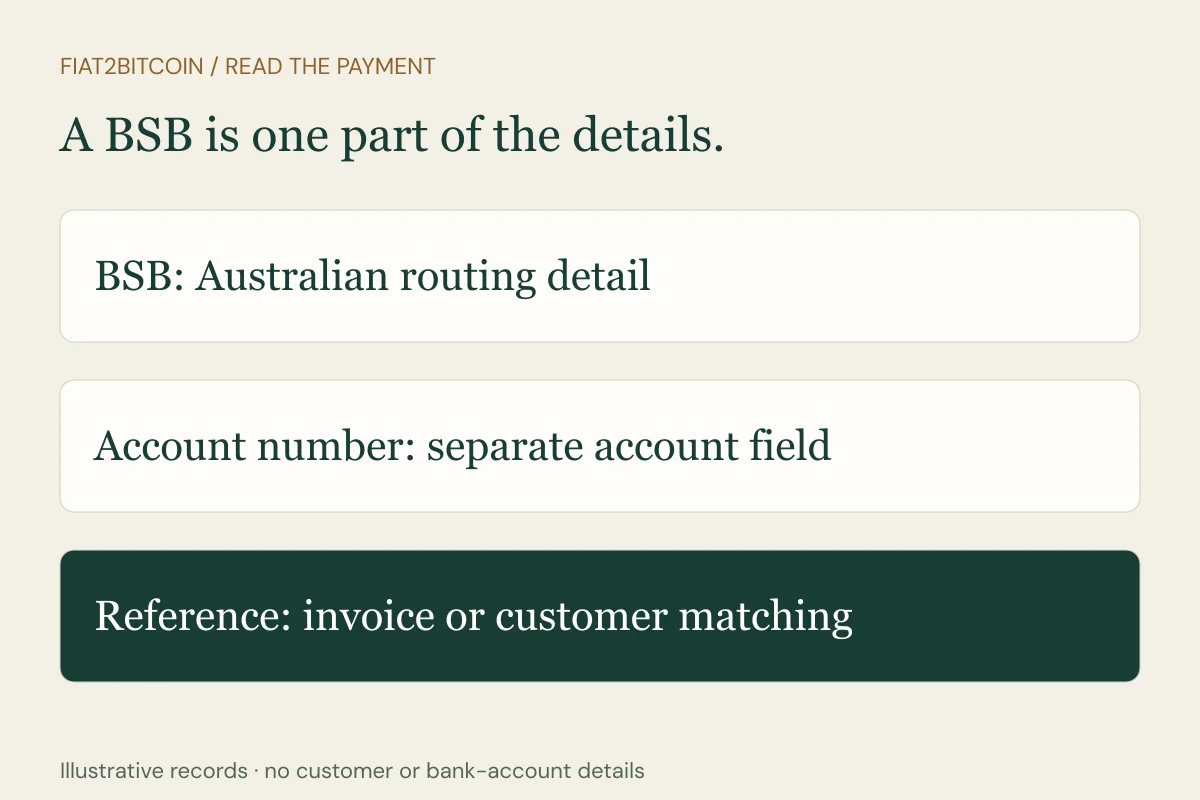
No. The BSB identifies the routing side; the separate account number identifies the account in that context. A payment reference identifies an invoice, customer or purpose and belongs to another field. Supplying a valid BSB does not replace a missing account number.
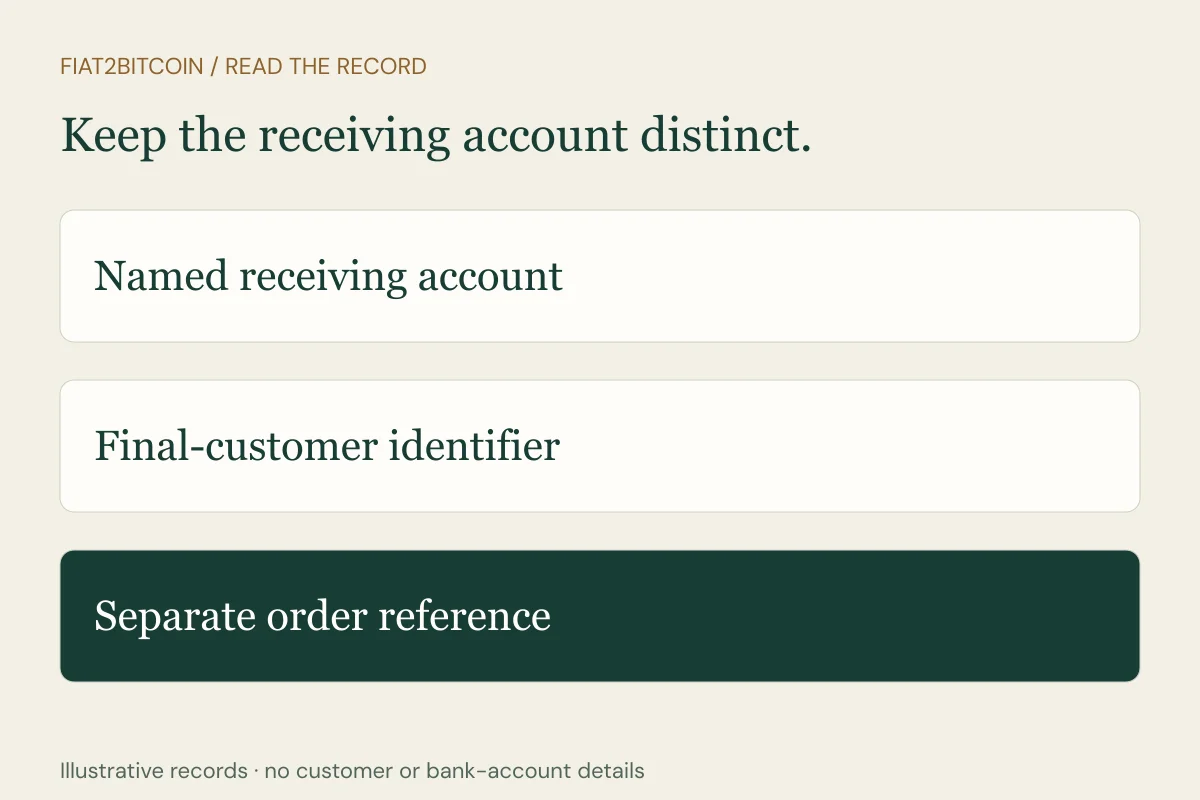
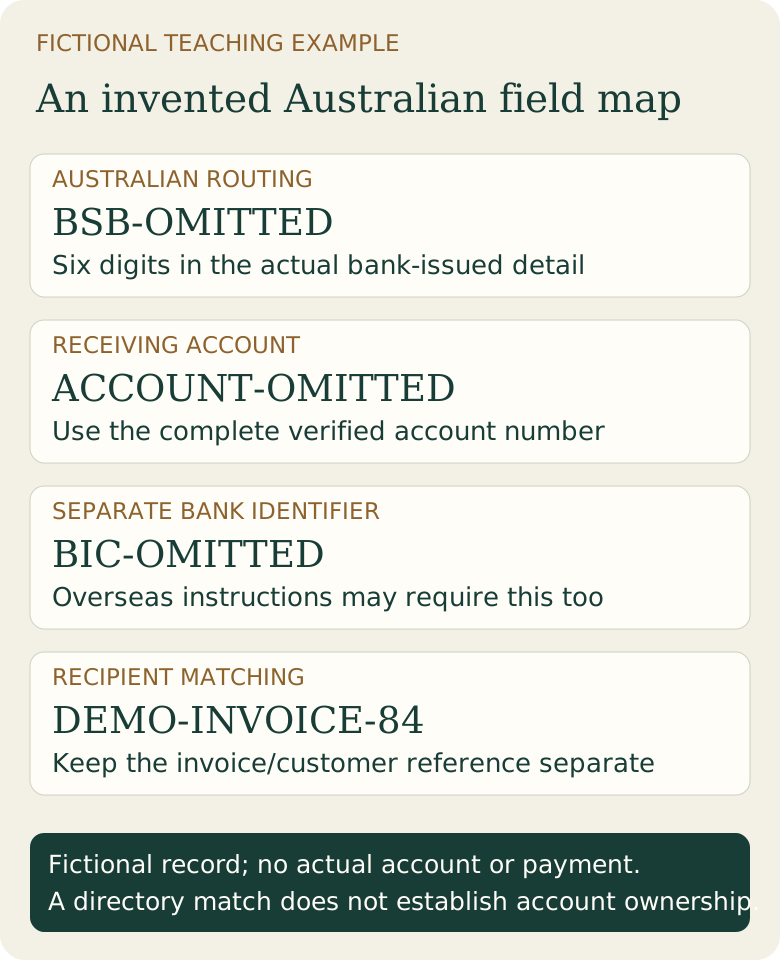
The original map below deliberately omits all usable banking details. Its purpose is to show field roles without giving a real bank route, account or transfer reference.
Scroll across the table to see all columns.
| Record label | Non-usable placeholder | Question it answers |
|---|---|---|
| BSB | BSB-OMITTED | Which Australian bank-routing entry? |
| Account number | ACCOUNT-OMITTED | Which receiving account? |
| Account name | Example Studio LLC — fictional | Which named recipient? |
| Payment reference | DEMO-INVOICE-84 | Which invoice/customer record? |
BSB vs SWIFT code: which is needed for an overseas transfer?
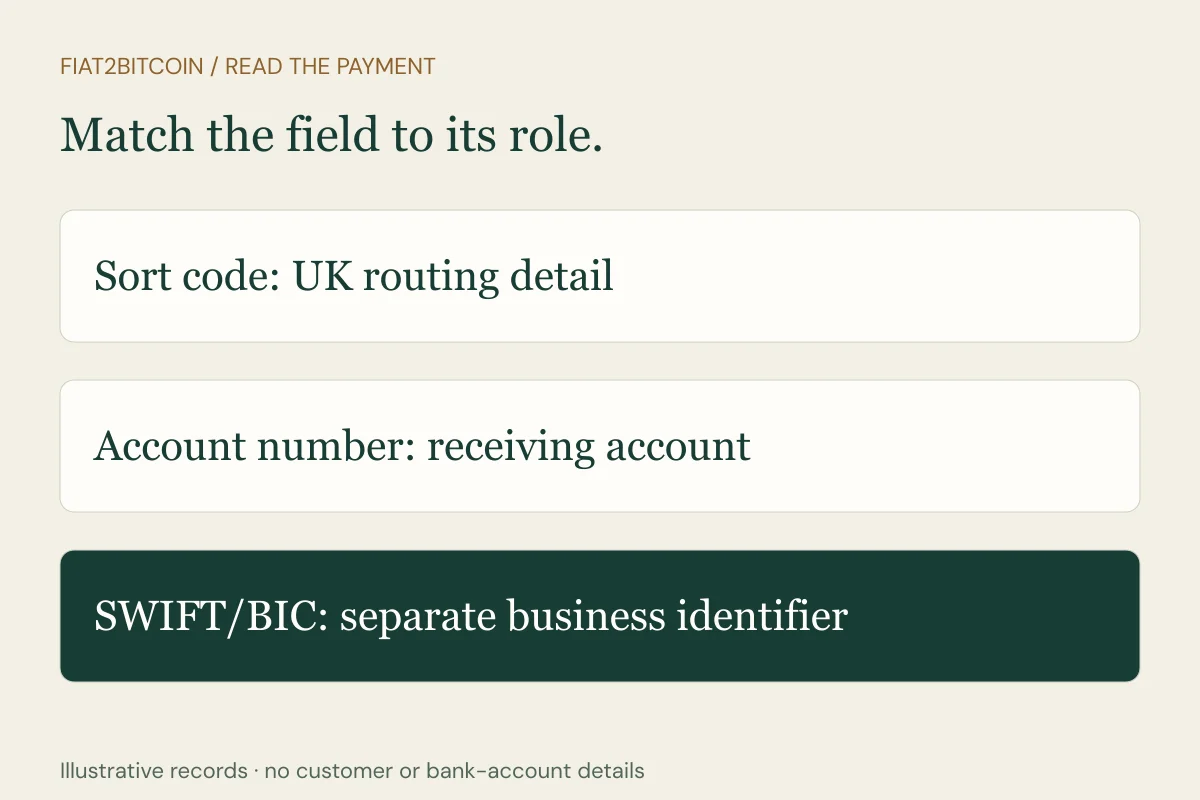
A BSB and SWIFT/BIC have different roles. Swift’s identifier explanation describes a business-party identifier with eight characters and an optional three-character branch element. A BSB is the Australian six-digit routing detail. Do not turn one into the other by adding a country prefix or deleting characters.
The receiving bank can specify both for a particular route. CommBank’s overseas receiving page lists its BIC/SWIFT alongside BSB and account details. That is one institution’s published example, not a universal instruction for every Australian account, currency or intermediary arrangement.
For a specific payment, get the receiving bank’s current instructions and ask the sending bank to map them to the actual form. A generic “routing number” field can be country-dependent. The ABA-versus-SWIFT guide explains the US bank-code distinction.
What if a form requires an Australian IBAN?
Do not create an IBAN by adding country letters, check digits or unrelated codes. Confirm the country and transfer-method selection, then explain that the recipient supplied Australian BSB/account details. Ask the sending service how it supports those details for the particular route.
CommBank’s receiving instructions say Australia does not use IBAN and, for certain overseas payer requests, describe combining its BSB and account number without spaces or hyphens. This is its own field-handling instruction; the combined value does not become an ISO IBAN. Have both banks confirm any such mapping for the actual payment rather than generalizing it to all institutions.
A useful fictional support prompt is: “The destination is an Australian account. Its verified instructions provide BSB, account number and SWIFT. Your form requires IBAN; which supported destination/method and field mapping should I use?” Share the real values only through the institution’s verified secure channel.
Where can you find a BSB, and what does a lookup prove?
For your own account, use the authenticated bank account-details screen or official statement. For a recipient, obtain its current verified details. The branch-name guide explains why a descriptive branch label is separate from the numeric identifier.
AusPayNet’s official BSB lookup provides institution and routing records and publishes a data-update notice. Its page warns that a missing NPP-enabled flag does not by itself establish that a BSB is unavailable for NPP payments; capability indicators have a specific scope. Confirm support for the actual route with the institution.
A directory entry cannot establish that a supplied account number belongs to your intended recipient, that an invoice is genuine or that money was credited. Keep account-name verification and required further-credit allocation separate. This guide provides no account lookup, ownership check or payment-status tool.
What if a BSB is rejected or the wrong details were sent?
Before sending, compare the complete BSB and account number with the verified source, check the country and method, and ask the bank about the exact warning. Preserve all required digits, including a leading zero. Do not replace a rejected code with one from a nearby branch or a public example.
If the payment was sent, contact the sending institution promptly with its receipt, amount, currency, date and reference. Ask what stage it reached and what investigation or correction process is available. Recovery depends on the actual transfer and institutions; a routing-code correction does not guarantee reversal. Resolve that payment before making another.
For a Bitcoin purchase, use the provider and methods actually displayed in checkout. Fiat2Bitcoin does not receive customer wires, issue bank instructions or hold purchase funds or crypto. Review current purchase options; understanding a BSB does not establish Australian domestic-payment eligibility.
Sources & further reading
These sources explain the payment systems and rules discussed in this guide. For your purchase, check the provider’s current offer and terms.
- ASIC Moneysmart: BSB and account-number roles
- ANZ: BSB/account payment terminology and account details
- AusPayNet: Official BSB directory and capability caveats
- Swift: BIC business-party and branch structure
- CommBank: Institution-specific overseas receiving fields
Published by Fiat2Bitcoin. Worked examples use fictional figures and records; they are not current prices or customer transactions. How we prepare our guides.