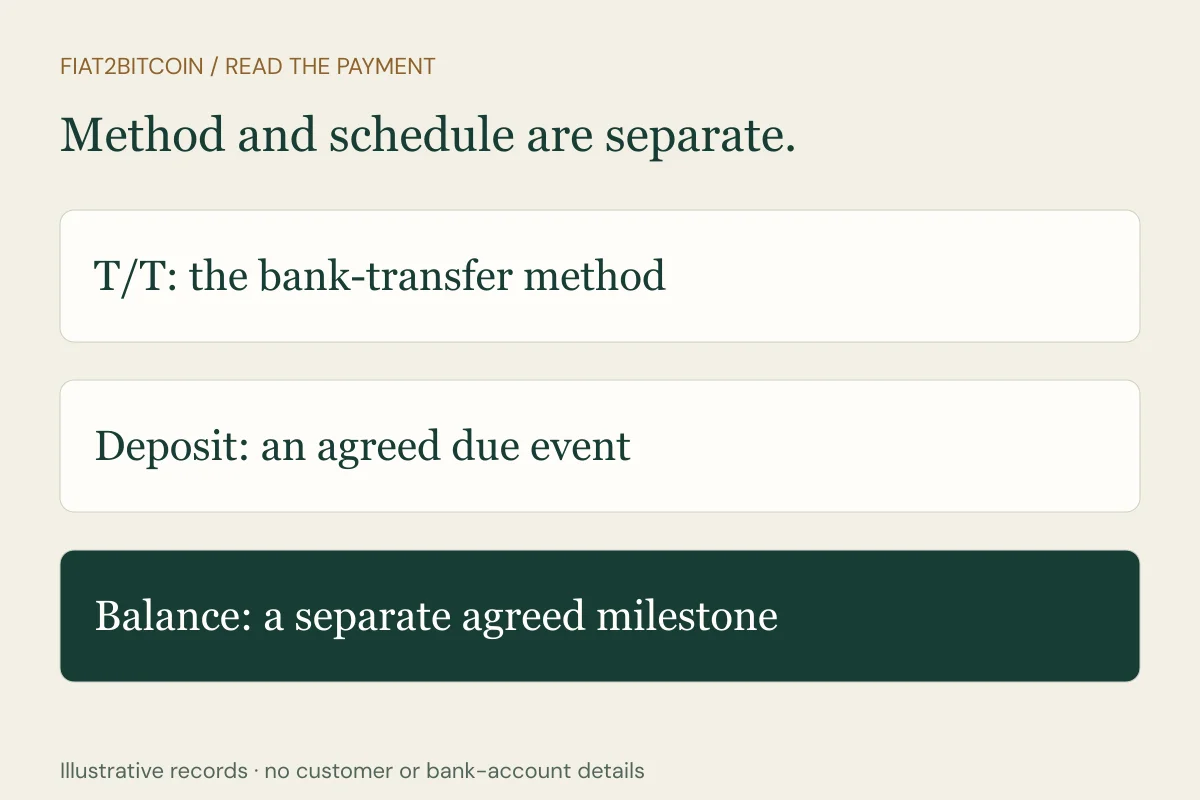
An invoice says “30% T/T deposit; balance before dispatch.” The transfer abbreviation and the commercial schedule answer different questions. Before making the bank payment, identify the agreed amount, the event that makes it due, the verified recipient and the evidence that will confirm receipt.
What does T/T stand for in a payment?
T/T or TT stands for telegraphic transfer. HSBC’s international banking glossary describes it as an electronic transfer method mainly used for overseas wire transactions. It is a banking term, not a cryptocurrency transaction or a promise that goods have shipped.
Banks do not all apply the label identically. Standard Chartered Hong Kong’s help page describes its telegraphic-transfer service as supporting overseas transfers and transfers to other local banks. Confirm the actual service, currency and destination with your bank rather than treating T/T as a single worldwide network.
A payment instruction may involve Swift messaging, a correspondent or another route selected by the institutions. The correspondent/intermediary guide explains those roles. The abbreviation alone does not reveal the number of banks involved or the charges along the route.
Does T/T mean payment in advance?
T/T tells you the method. The surrounding agreement tells you the schedule. “T/T in advance,” “deposit by T/T,” and “balance by T/T” describe different payment obligations. Do not assume an unstated percentage, shipment trigger or credit period simply because the invoice uses the abbreviation.
The US International Trade Administration’s cash-in-advance guide lists wire transfers among ways exporters receive advance payment and explains the different interests of buyer and exporter. Payment before shipment exposes the buyer to a separate performance question: will the seller provide what was agreed?
If payment depends on an inspection, document, milestone or delivery event, obtain an agreed definition of that event. A bank confirmation reports a payment event; it does not independently inspect goods, certify contract performance or create escrow protections.
Worked example: a 30% deposit and a 70% balance
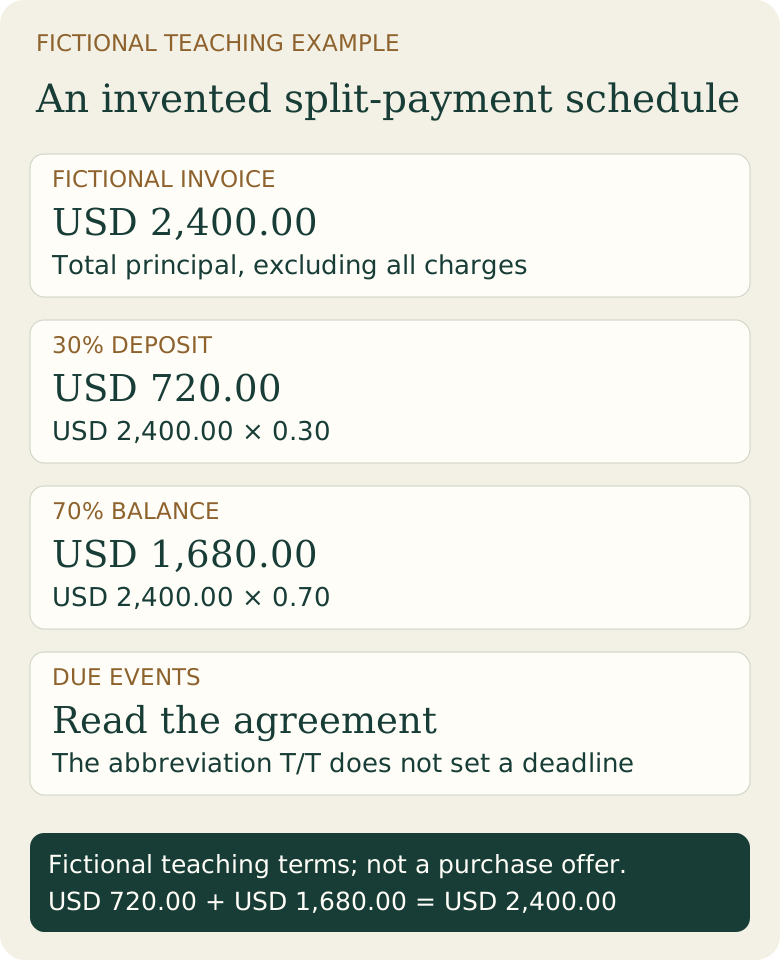
Assume a fictional USD 2,400.00 invoice, with a 30% deposit and the remaining 70% payable at an agreed later milestone. The deposit is USD 720.00 and the balance is USD 1,680.00. Those amounts total USD 2,400.00. This is an arithmetic illustration, not a recommendation to accept these terms.
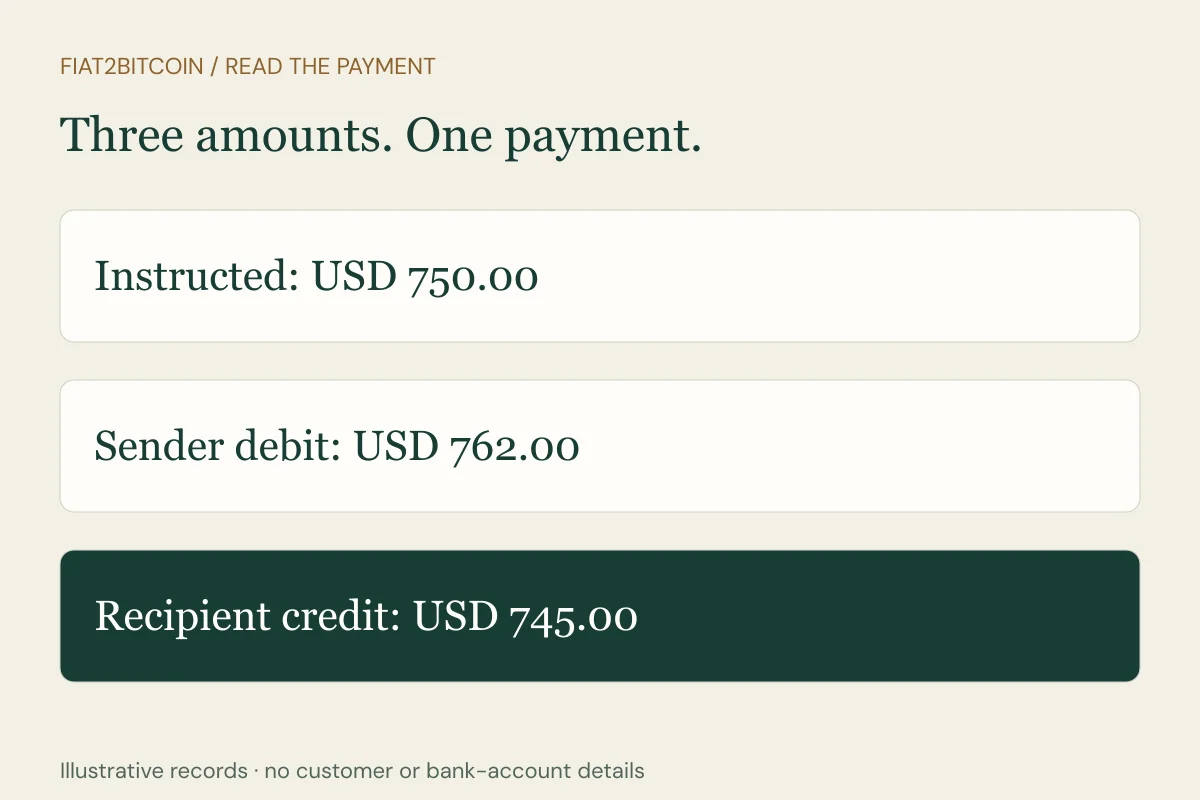
If the sending bank adds an invented USD 10.00 fee to each of two payments, the sender’s two debits would be USD 730.00 and USD 1,690.00: USD 2,420.00 in total. The extra USD 20.00 is sending-bank cost in this example, not additional invoice principal. Exchange conversion, receiving deductions, taxes and all other charges are excluded.
Scroll across the table to see all columns.
| Payment | Invoice principal | Due event to verify |
|---|---|---|
| 30% deposit by T/T | USD 720.00 | The event specified in the agreement |
| 70% balance by T/T | USD 1,680.00 | The separately agreed later milestone |
| Invoice total | USD 2,400.00 | Not proof of payment or delivery |
What information belongs in the bank instruction?
Use current, independently verified recipient instructions. Confirm the beneficiary name, receiving account, bank identifier, currency and payment reference. A supplier nickname is not necessarily the legal account-holder name.
If an intermediary account or further-credit line appears, ask the bank to map the account holder and final recipient before payment. The further-credit guide covers that allocation detail. A postal remittance address serves a different purpose from a receiving account.
Check a requested change through an established contact route. The FBI’s business-email-compromise guidance describes fraudulent payment requests and recommends independently confirming changed procedures. Do not use only the replacement phone number included in the change request.
What should you ask about fees and transfer time?
Ask which amount leaves your account, which currency is sent, whether conversion applies, who bears each stated charge and what the recipient is expected to receive. Read any OUR, SHA or BEN option in the actual service’s terms. The receipt charge checklist helps separate a fee label from a guaranteed net amount.
The bank’s cutoff, release, review, intermediary processing and recipient credit can be separate stages. A same-day submission or an “urgent” option does not prove same-day recipient availability. Use the cutoff guide and ask the bank about the specific route rather than relying on a generic T/T timeline.
Which record confirms that a T/T payment reached its purpose?
Keep the official receipt, the bank-created transfer identifier and the recipient’s invoice reference. Ask the receiving business to confirm the credit and its allocation to the deposit or balance. Resolve a missing transfer with the bank before paying again. A screenshot or supplier email alone cannot establish every stage.
For a Bitcoin purchase, a provider order and blockchain delivery remain separate from the bank payment. Fiat2Bitcoin does not receive customer wires or issue bank instructions. Compare current purchase methods; the provider and route actually shown in checkout determine your available options. Supplier T/T terms in this guide are not Fiat2Bitcoin payment terms.
Sources & further reading
These sources explain the payment systems and rules discussed in this guide. For your purchase, check the provider’s current offer and terms.
- HSBC International: Telegraphic-transfer terminology
- Standard Chartered Hong Kong: Scope of its TT service
- International Trade Administration: Cash-in-advance payment methods and tradeoffs
- FBI: Verify payment requests and changed instructions
Published by Fiat2Bitcoin. Worked examples use fictional figures and records; they are not current prices or customer transactions. How we prepare our guides.